AI Agent for Travel Agencies: Automating Sales & Support
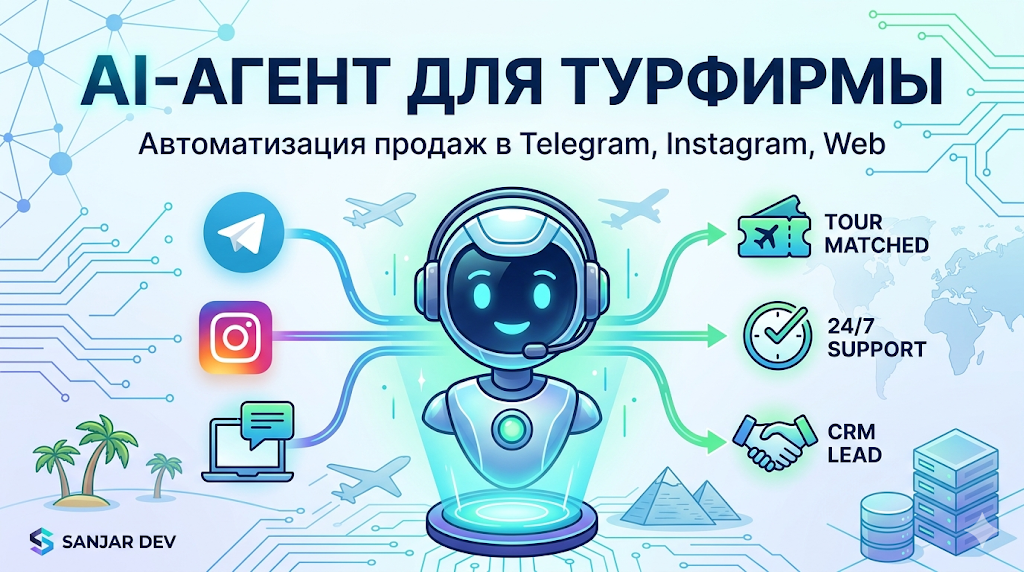
Discover how implementing an AI agent helps travel companies process requests 24/7 via Telegram, Instagram, and website chat, boosting conversion rates.
The Problem: Missed Clients and Burnout
In the travel industry, speed is everything. Clients look for tours in the evenings or on weekends. If your manager doesn't reply within 5-10 minutes, the client goes to a competitor.
Key problems of classic travel agencies:
- Manager burnout: Processing hundreds of identical questions ("How much is a ticket to Dubai?").
- Loss of leads: Requests coming in at 2:00 AM remain unanswered until morning.
- Fragmentation: Clients write in Telegram, Instagram Direct, and the website chat, causing chaos.
Context: Why an AI Agent is Better Than a Chatbot
Unlike traditional bots with strict button menus, a modern AI agent is built on NLP/LLM (like GPT-4). It understands natural language, context, and typos.
Capabilities of the agent:
- Omnichannel: Works seamlessly via Telegram-bot, Web-chat, and Instagram Direct.
- 24/7 Availability: Answers instantly at any time.
- FAQ and Selection: Qualifies leads by asking about dates, budget, and passenger count.
The Solution in Action: Features & CRM Integration
Let's look at a real-world application. Services like ai-xodim.uz provide comprehensive virtual employee solutions. The workflow is simple:
- A client texts on Instagram: "I want to go to Maldives next week for 2 people with a $2000 budget."
- The AI parses the parameters (Destination: Maldives, Dates: next week, Budget: $2000).
- It connects to the travel agency's CRM via API to check available packages.
- The AI replies with options and saves a warm lead directly to the CRM (e.g., Bitrix24 or amoCRM).
This automates up to 70% of routine manager conversations.
Implementation Example (For Developers)
Under the hood, integrating such an agent requires setting up webhooks and an LLM orchestrator. Here is a simplified code example using Node.js to handle a Telegram webhook:
app.post('/webhook/telegram', async (req, res) => {
  const message = req.body.message.text;
  const chatId = req.body.message.chat.id;

  // Process with LLM
  const aiResponse = await processWithLLM(message, context);

  // Send reply
  await sendTelegramMessage(chatId, aiResponse);
  res.sendStatus(200);
});
The processWithLLM function uses tools (function calling) to trigger external APIs (CRM search, currency converter).
Pitfalls & Best Practices
When launching an AI agent, developers and travel agencies make common mistakes. Here is how to avoid them:
- Don't pretend to be human: Always disclose that the user is talking to an AI assistant. This builds trust.
- Human Handover: Implement a seamless transition. If the AI doesn't know the answer or the client is ready to buy, route the chat to a live manager immediately.
- Prompt Engineering: Give the AI clear boundaries. It should only discuss travel topics and refuse to answer unrelated questions to avoid hallucinations.
Conclusion & Next Steps
An AI agent is not a distant future, but a necessary tool for survival in the travel business today. It reduces response time to seconds, captures night-time leads, and frees managers for high-value sales.
Ready to modernize your travel agency? Explore solutions like ai-xodim.uz or start building your own prototype using an open API. Automate your support and watch your conversion rates grow!