Employee Attendance Sheet Template (Excel) and How to Fill It
A free employee attendance sheet template in Excel with codes and totals, and Uzbekistan's rules on recording hours, the 40-hour week, overtime and phone check-ins.
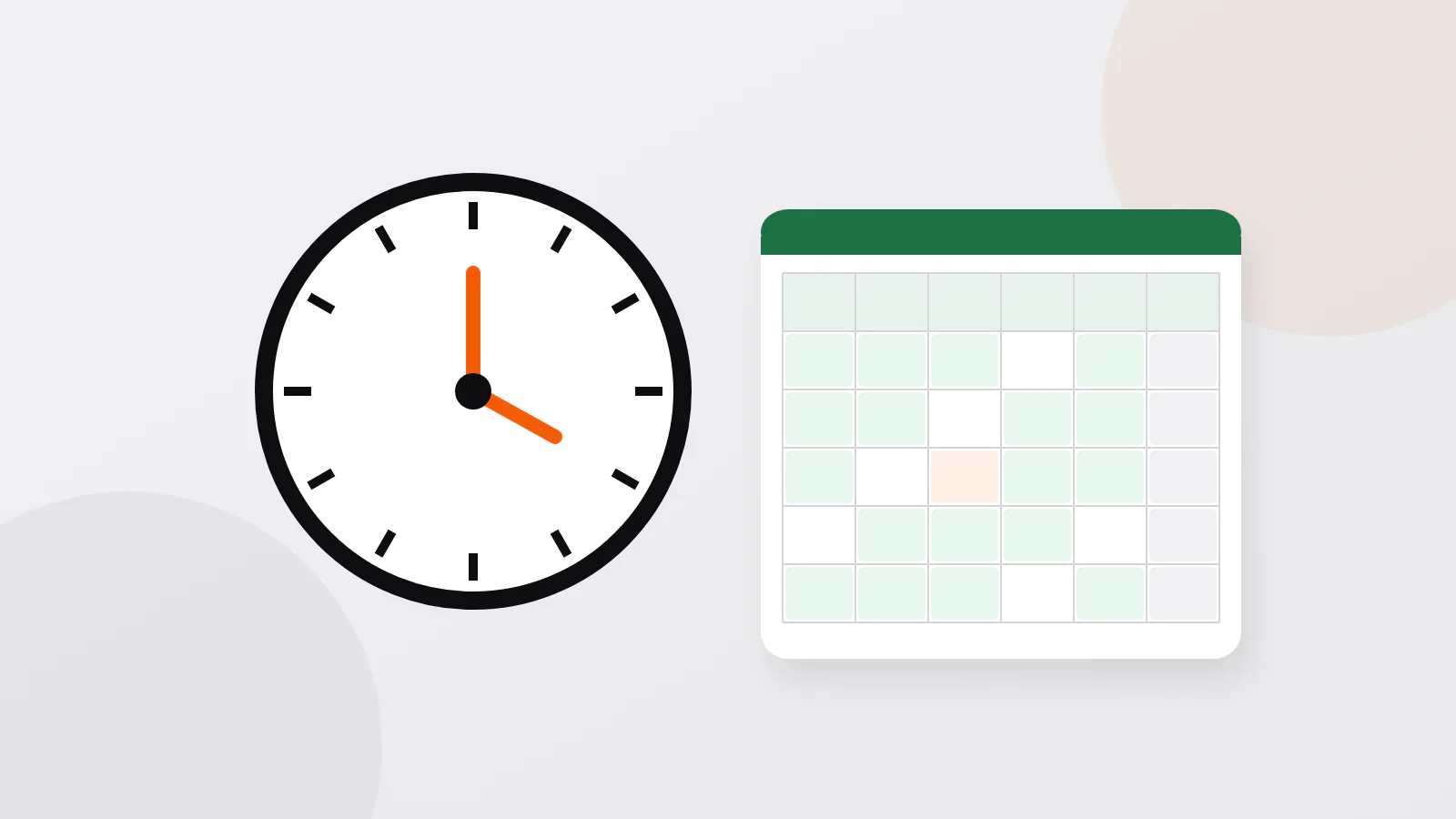
An attendance sheet, or timesheet, is a table with one row per employee and one column per day of the month: you type the hours worked or a code for a day off, sick leave, vacation or absence, and the totals feed into payroll. In Uzbekistan every employer must record when employees arrive and leave (Labour Code, Art. 200), and a paper book, a spreadsheet, a terminal or a phone app are all allowed. Our free Excel template adds up the days and hours for you.
What the law requires
The Labour Code of 2022, in force since 30 April 2023, sets out what an employer has to record:
- Arrival and departure. The employer must organise records of when people come to work and leave. They are kept in timesheets and other documents and may be made with hardware or software (Art. 200).
- Actual work time, from arrival at the workplace to the end of the shift. The commute, changing clothes and registering at the exit are not work time (Art. 200).
- Extras shown separately: overtime, business trips and internal part-time work. Time not worked is split into paid and unpaid, and into losses with or without the employee's fault.
- Normal hours: no more than 40 hours a week (Art. 182); no more than 8 hours a day on a five-day week or 7 hours on a six-day week (Art. 185). The day before a public holiday is at least one hour shorter (Art. 187).
- Overtime needs the employee's written consent, may not exceed 4 hours over two days in a row, and must be recorded precisely (Art. 189 and 190). Night time is from 22:00 to 06:00 (Art. 188).
Accurate hours matter because overtime, night work and holidays are paid at higher rates; our payroll guide gives the numbers.
How to fill in a monthly timesheet
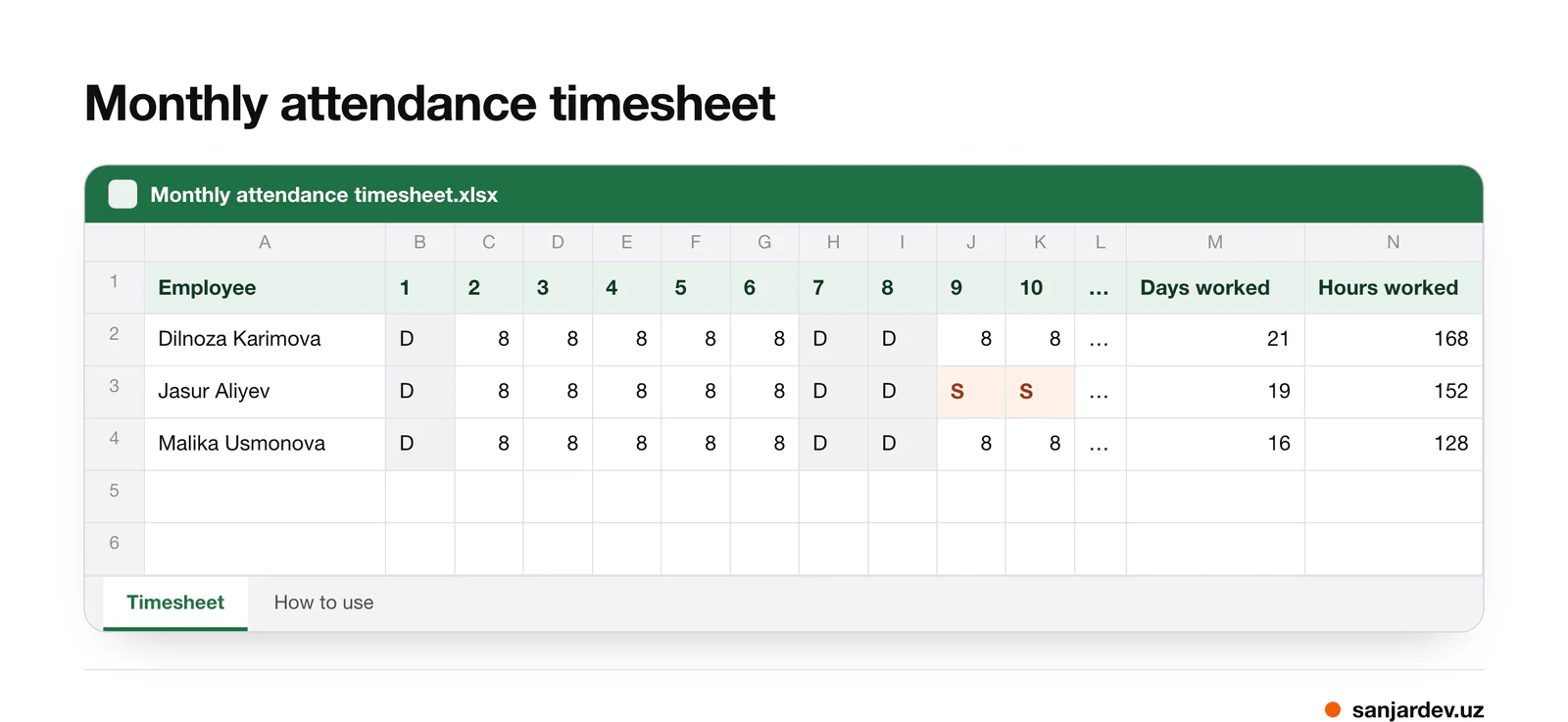
- Write the company and the month at the top.
- Give each employee a row with a number, name and position.
- For each day worked, type the hours: 8, 7, or 9 if there was an hour of overtime.
- For other days, type a letter code from the table below.
- The totals on the right count days worked, hours worked, days off, sick days, vacation days and absences.
- Compare the hours with the month's norm in the next section. A large gap means a mistake or unrecorded overtime.
- At the end of the month the person who kept the sheet and the manager sign it. Keep it with your payroll records.
| Code | Meaning | When to use it |
|---|---|---|
| 8 (any number) | hours worked | every day the employee worked; type the actual hours |
| D | day off or public holiday | weekly days off, holidays and transferred days off |
| S | sick leave | days covered by a medical certificate |
| V | vacation | annual leave, at least 21 calendar days a year (Art. 217), and other leave |
| A | absent | absence without a valid reason |
The letter codes are the template's own. The Labour Code speaks of timesheets "of the established form", but we did not find a current official form with codes on lex.uz. If your accountant works with other codes, agree on one set and keep it the same every month.
Working-time norm for 2026
The Ministry of Employment and Poverty Reduction publishes a working-time calendar every year. For 2026 it gives 1,979 hours and 248 working days on a five-day, 40-hour week, and 1,977 hours and 297 days on a six-day, 40-hour week. The ministry presents the calendar as a recommendation for normal schedules; it does not apply to shift work.
| Month 2026 | Working days, five-day week | Hours, five-day week |
|---|---|---|
| January | 20 | 160 |
| February | 20 | 160 |
| March | 19 | 151 |
| April | 22 | 176 |
| May | 17 | 134 |
| June | 22 | 176 |
| July | 23 | 184 |
| August | 20 | 160 |
| September | 21 | 167 |
| October | 21 | 168 |
| November | 21 | 168 |
| December | 22 | 175 |
| Year | 248 | 1,979 |
On a five-day week the days off behind these numbers are 1 and 2 January; 9 March (for 8 March, a Sunday); 20 March, the first day of Ramazon hayit; 23 March (for Navruz on Saturday 21 March); 11 May (for 9 May); 27 May, Qurbon hayit, with 28 and 29 May; 31 August and 1 September; 1 October; 8 December; and 31 December, moved from Saturday 12 December, which becomes a working day. Six-day weeks have slightly different transfers, set by presidential decree UP-257 of 24 December 2025.
Paper, Excel, a terminal or a phone
| Method | Works well when | Watch out for |
|---|---|---|
| Paper attendance book | one site, a few people, a manager on the spot | entries written later from memory; no totals |
| Excel timesheet | one person fills it in every day and sends the totals to payroll | it shows what someone typed, not when people actually came |
| Card, fingerprint or face terminal | one entrance, many people | fingerprints and face templates are biometric data |
| Phone check-in with location and selfie | several branches, staff who travel | consent, GPS errors, people without smartphones |
Whatever you choose, the timesheet is where the month comes together: a terminal or an app gives you the times, and the sheet turns them into days and hours. A good timesheet also answers questions that come up later, for example who was on shift when a shortage appeared in a stock count.
Location, selfies and face checks: consent first
The Labour Code allows attendance to be recorded with software (Art. 200), but the location, the photo and any face template are personal data. The Law on Personal Data (ZRU-547) and the Labour Code set the rules:
- Explain first. Tell employees what you collect, why and how, and what happens if they refuse consent, and have them sign that they have read your rules on personal data (Labour Code, Art. 176). Employees' personal data are confidential (Art. 175).
- Use the data only for that purpose. Checking attendance is not a reason to follow where people go after work (Law on Personal Data, Art. 19). Ask for the location at check-in and check-out only, not all day.
- Face checks need consent. A face check compares a selfie with a reference photo to confirm who is checking in. Biometric data used to identify a person may be processed only with that person's consent (Art. 26). Since 27 March 2026 biometric data must be stored in Uzbekistan (Art. 27-1), so ask any provider where it keeps them.
- Offer a fallback. A manager can mark a person who has no smartphone or whose phone failed, with a note why.
Fair rules for lateness
- Write the working hours and how lateness is handled into the internal labour rules, and show them to every employee before you apply them.
- Agree on a small grace period and apply it to everyone, including managers.
- Keep pay and penalties apart. Paying for the hours actually worked is one thing. A fine is a disciplinary sanction: no more than 30% of the average monthly wage, or 50% if your internal rules provide for it. You must first ask for a written explanation, and the order has to be shown to the employee within three working days (Art. 312 and 313).
- Sanctions that are not in the Code are not allowed, and all deductions from one payment together may not exceed 50% of it (Art. 270).
- Look at the pattern over a month, not single minutes. Three late mornings in a week say more than one bus that never came.
How to use the template
Download the timesheet template (Excel)
- Make a copy of the sheet for each month and write the month and the company in the header.
- Type hours or codes into the day cells; the totals update by themselves.
- If someone works on a day off or a holiday, type the hours anyway: the higher pay is worked out in payroll.
- The "How to use" sheet repeats the codes, so anyone who fills in the sheet uses the same letters.
FAQ
Is an attendance sheet mandatory in Uzbekistan?
The Labour Code requires every employer to record when employees arrive and leave (Art. 200). It allows timesheets, other documents and software, so a spreadsheet or an app is fine as long as the records are complete and kept.
How many working hours are there in 2026?
According to the ministry's calendar, 1,979 hours in 248 days on a five-day, 40-hour week and 1,977 hours in 297 days on a six-day, 40-hour week. On a five-day week November has 168 hours and December 175.
Can I track employees by phone location?
You can ask for the location at check-in and check-out, with written rules that employees have read, and with consent for face checks. Following people outside working time goes beyond the purpose of attendance.
Can I fine an employee for being late?
A fine is a disciplinary sanction under the Labour Code: up to 30% of the average monthly wage, or 50% if the internal rules say so, only after a written explanation and by an order (Art. 312 and 313).
Which codes should I use for sick leave and vacation?
In our template, S for sick leave and V for vacation. We found no single compulsory set of codes in the current law, so choose one set and use it consistently.
How MyBizz helps
In MyBizz (App Store, Google Play), the business app we develop, employees check in and out with one tap on their phones. A location and a selfie confirm that the check-in was made at the workplace; a face check against a reference photo and check-in only inside the work zone can be switched on. The manager sees the team timesheet, with who is at work and who is late, gets notifications in the app or in Telegram, and can export the records to Excel or PDF. Each branch can have its own work zone and schedule. MyBizz does not keep sick leave or vacation days, so mark those on the timesheet. The app is free to download and free during the trial period; after that a company needs a paid plan, priced by the number of employees.
Sources
- Labour Code of the Republic of Uzbekistan, Art. 175–200, 217, 270, 312–313 (in Russian) — lex.uz, 2022, amended 2026
- Law ZRU-547 on personal data, Art. 19, 26, 27-1 (in Russian) — lex.uz, 2019, amended 2026
- Law ZRU-1125 amending the Law on personal data (in Russian) — lex.uz, 2026
- Working-time calendar for 2025 and 2026, letter No. 01/00-04/15-12669 (in Uzbek) — Ministry of Employment and Poverty Reduction, 2025
- Decree UP-257 on additional non-working days and transferred days off in 2026 (in Russian) — lex.uz, 2025
Written by Sanjar Jabborov, developer of MyBizz. Checked against the Labour Code and the Law on Personal Data of Uzbekistan (lex.uz) and the ministry's working-time calendar for 2026. Updated on 14 November 2026. This is general information, not legal advice.