How to Do a Stock Count in a Shop: Steps and a Free Count Sheet
How to do an inventory count in a shop: when to count, how to prepare, blind counting in pairs, comparing with records and shortages, with a free count sheet.
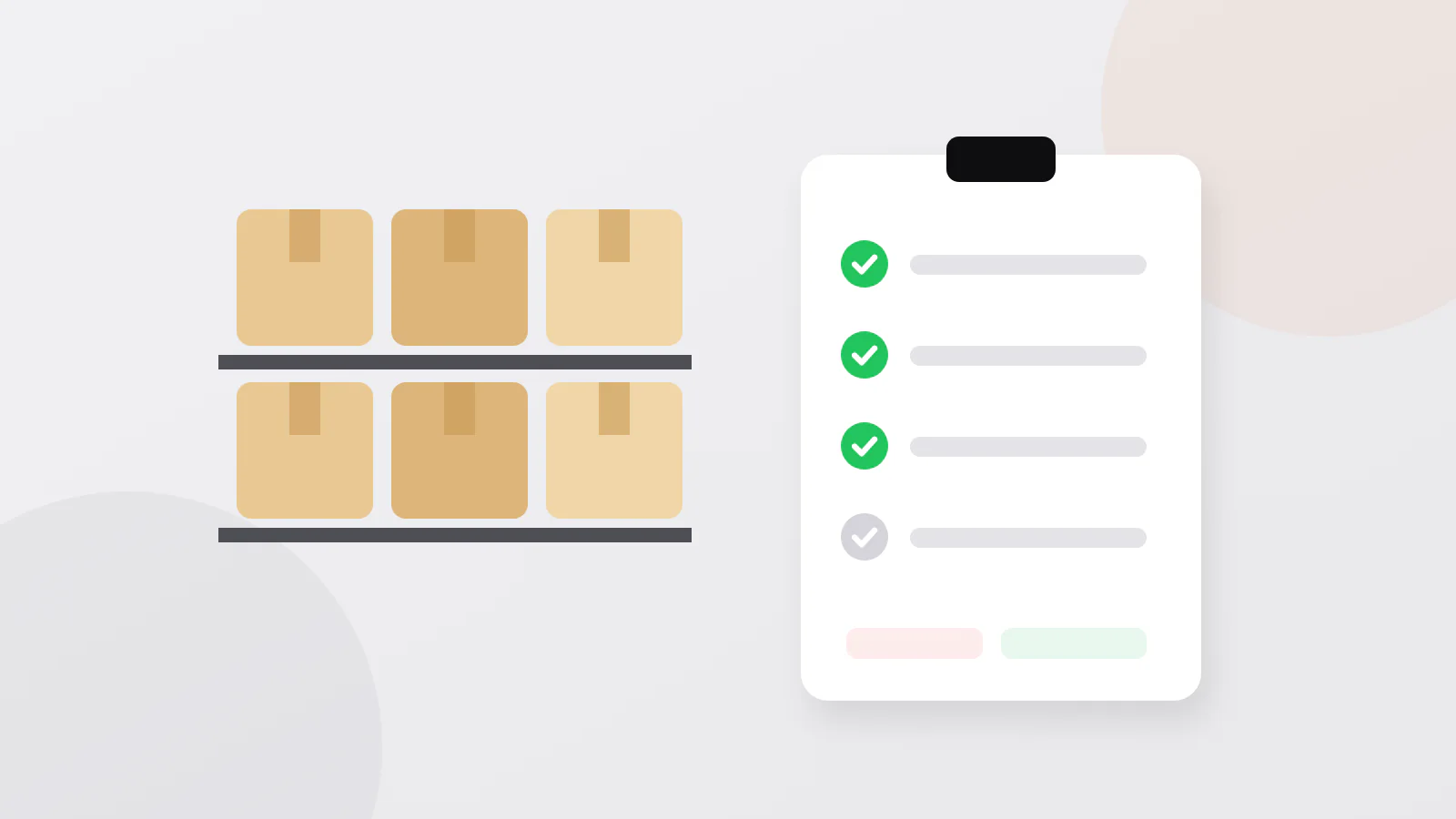
A stock count, or stock take, means counting every item in the shop and the storeroom at one moment and comparing the result with your records. Stop sales and deliveries, count in pairs shelf by shelf without looking at the recorded quantities, have the person responsible for the goods sign the sheets, and explain each difference before you change the stock in your records. The free count sheet below comes as a printable PDF and as an Excel file that works out the differences for you.
When to count
Companies in Uzbekistan follow national accounting standard No. 19, "Organisation and carrying out of an inventory count" (BHMS 19, in Russian NSBU 19). A new version has applied since 12 August 2024. The Law on Accounting makes the count compulsory (Art. 16), and the standard says when. The same moments make sense for a small shop even where the standard does not bind it:
| Moment | What BHMS 19 says for companies | Suggestion for a small shop |
|---|---|---|
| Regular count | goods at least once a year, and before the annual financial statements (a count after 1 October of that year is enough) | a full count every three to six months, plus short weekly counts of fast-moving or expensive goods |
| New responsible person | on the day the materially responsible person hands over | always: the new person accepts exactly what was counted |
| Theft, abuse or spoilage | as soon as it is found | count at once, before the shop opens again |
| Fire, flood or another emergency | after the event | count what is left and take photos |
| Selling, buying or renting out property | compulsory | count together with the other side |
| Cash on hand | once a month | count the cash box every evening |
The standard is written for companies and budget organisations. Individual entrepreneurs keep records in the way the law sets for them (Law on Accounting, Art. 6), so ask your accountant what applies to you. The steps below work for any shop.
Prepare the day before
- Choose the time: after closing or before opening, when nothing is sold. Ask suppliers not to deliver that day.
- Close the documents. Enter every delivery, sale and return up to the moment of the count, and write down the number of the last receipt and the last delivery note. In a company the commission marks the last documents "before the count", and the responsible person signs that all documents have been handed in (BHMS 19, item 10).
- Tidy the shelves. Put the same goods together, keep one item in one place where you can, and label the zones.
- Set aside what you count separately: damaged goods, returns waiting for the supplier, and goods that belong to someone else, such as goods taken on consignment (item 16).
- Print the count sheets, one or more per zone, and check that the scales are accurate.
- Make teams of two: one person counts, the other writes. The person responsible for the goods must be present (item 14). A company appoints an inventory commission by an order (item 8).
Count blind, in pairs, shelf by shelf
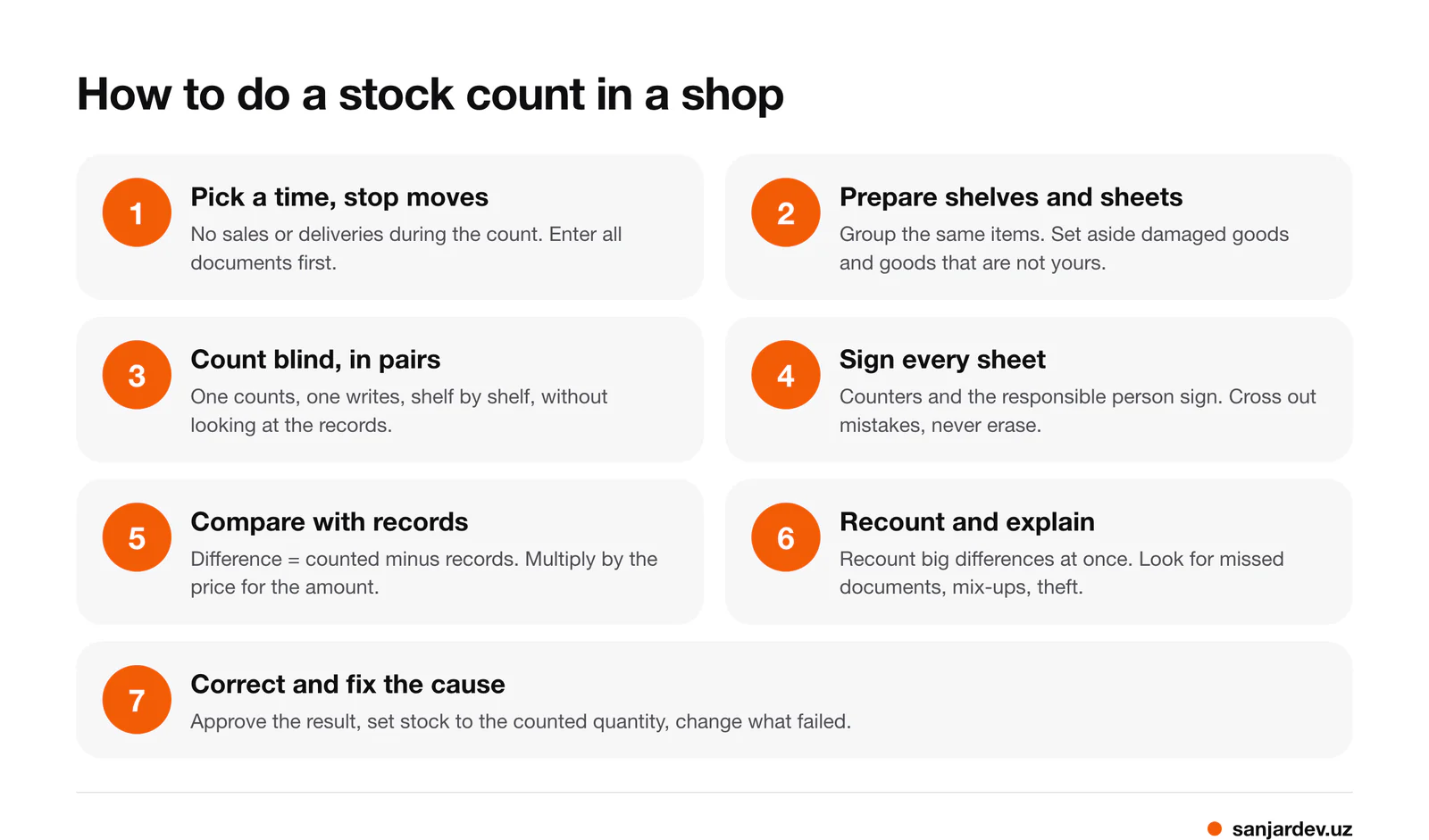
- Count blind. Counters write what they see without the recorded quantity in front of them, so nobody "finds" the number they expect. The "In records" column is filled in later.
- Count, weigh or measure every item. Unopened supplier boxes may be taken from the documents, but open a few to check (item 14).
- Move in one direction, left to right and top to bottom, and mark each shelf as done.
- Write clearly and never erase. Cross out a mistake, write the right number and sign next to it. Leave no empty lines, and write the number of entries at the bottom of each page (item 18).
- Sign every sheet: the counters and the responsible person (item 16).
- Seal the room overnight. If the count takes more than one day, lock and seal the storeroom when you leave (item 11).
Compare with the records
After the count, fill in "In records" from your program or notebook. The difference is counted minus in records; multiply it by the price to see the amount. With example prices:
| Item | In records | Counted | Difference | Price, so'm | Difference amount, so'm |
|---|---|---|---|---|---|
| Sunflower oil, 1 l | 48 | 45 | −3 | 21,000 | −63,000 |
| Sugar, 1 kg | 60 | 61 | +1 | 13,000 | +13,000 |
| Black tea, 100 g | 30 | 30 | 0 | 15,000 | 0 |
Use one kind of price for the whole sheet, usually the purchase price; companies value differences at their accounting value (item 68).
Recount every large difference at once, before the shop opens. The standard accepts explanations of counting errors only until the storeroom is opened again (item 19). Then look for the reason:
- a sale or a return that was not entered;
- a delivery received but not entered, or entered twice;
- similar goods mixed up, which shows as a surplus of one size and a shortage of another;
- spoilage, or the natural loss of weight in loose goods;
- theft.
Look at shortages and surpluses separately rather than letting them cancel out. A surplus is a warning too: it usually means a mistake somewhere else. When you look for causes, the attendance timesheet shows who was working on the days in question.
Shortages and surpluses: what to do
- In a company (item 69), a surplus is taken into income. A loss within the official natural-loss norms is written off by the manager's order. A shortage above the norms is charged to the person at fault or, if nobody is found responsible, written off under the rules. The result is recorded in the month the count ends (item 70).
- In a small shop, approve the result, set the stock in your records to the counted quantity, and write the reason next to each large difference.
- Do not simply take a shortage out of a salary. Without the employee's written consent, the Labour Code allows deducting damage only up to the employee's average monthly wage, and all deductions from one payment together are limited to 50% of it (Art. 269 and 270).
- Fix the cause. Check deliveries against the invoice when they arrive, enter returns at once, keep expensive goods near the till, and count your ten riskiest items every week.
The cash box is part of the same picture: count it against your cash book every evening.
Using the count sheet
Download the printable count sheet (PDF)
Download the count sheet (Excel)
- Fill in the shop, the date and the names at the top.
- Counters fill in only the item, code, unit and the counted quantity.
- After the count, add "In records" and the price. The Excel version calculates the difference and its amount.
- The counter, the checker and the responsible person sign at the bottom.
For companies, the official forms are annexed to BHMS 19: an inventory list of goods and a comparison statement of the results. Our sheet holds the same information for a small business; use the official forms if your accountant asks for them.
FAQ
What is a stock take?
Another name for a stock count: counting all goods at one moment and comparing the result with the records, so that the records show what is really on the shelves.
How often should a shop do a stock count?
Companies must count goods at least once a year and before the annual statements (BHMS 19, item 5). Most shops do better with a full count every few months and short weekly counts of fast-moving or expensive goods.
Who should do the count?
At least two people per zone, one counting and one writing, with the person responsible for the goods present. In a company an inventory commission appointed by an order does it; if one of its members is absent, the results can be declared invalid (item 8).
What documents does a company need after an inventory count in Uzbekistan?
The order appointing the commission, the inventory lists signed by the commission and the responsible persons, and a comparison statement for the items with differences. The forms are annexed to BHMS 19; your accountant records the results.
Can I deduct a shortage from the seller's salary?
Only within the Labour Code limits: with the employee's written consent, or without it for damage up to their average monthly wage, and never more than 50% of a single payment (Art. 269 and 270).
How MyBizz helps
MyBizz (App Store, Google Play), the business app we develop, keeps products and stock across several warehouses. For a count you start a stock count for a warehouse or a category, type the quantities or scan barcodes with the phone camera, each scan adding one, save as you go and complete the count: MyBizz shows the shortages and surpluses and sets the stock to the counted quantity. The count screen shows the recorded quantity next to the counted one, so for a blind count use the printed sheet first and enter the numbers afterwards. MyBizz does not replace the official forms a company's accountant may need. The app is free to download and free during the trial period; after that a company needs a paid plan, priced by the number of employees.
Sources
- National accounting standard No. 19 "Organisation and carrying out of an inventory count" (in Uzbek) — Ministry of Economy and Finance, lex.uz, 2024
- Order No. 141 approving national accounting standard No. 19 (in Russian) — lex.uz, 2024
- Law on Accounting, Art. 6 and 16 (in Russian) — lex.uz, 2016
- Labour Code of the Republic of Uzbekistan, Art. 269–270 (in Russian) — lex.uz, 2022
Written by Sanjar Jabborov, developer of MyBizz. Checked against Uzbekistan's national accounting standard No. 19 (2024 version) and the Law on Accounting (lex.uz). Updated on 14 November 2026. This is general information; in a company, the accountant decides how the results are recorded.