Gestational Diabetes: Blood Sugar Levels and When to Check
Gestational diabetes blood sugar targets (ADA 2026): fasting, 1 and 2 hours after meals in mg/dL and mmol/L, the glucose test, how often to check, after birth.

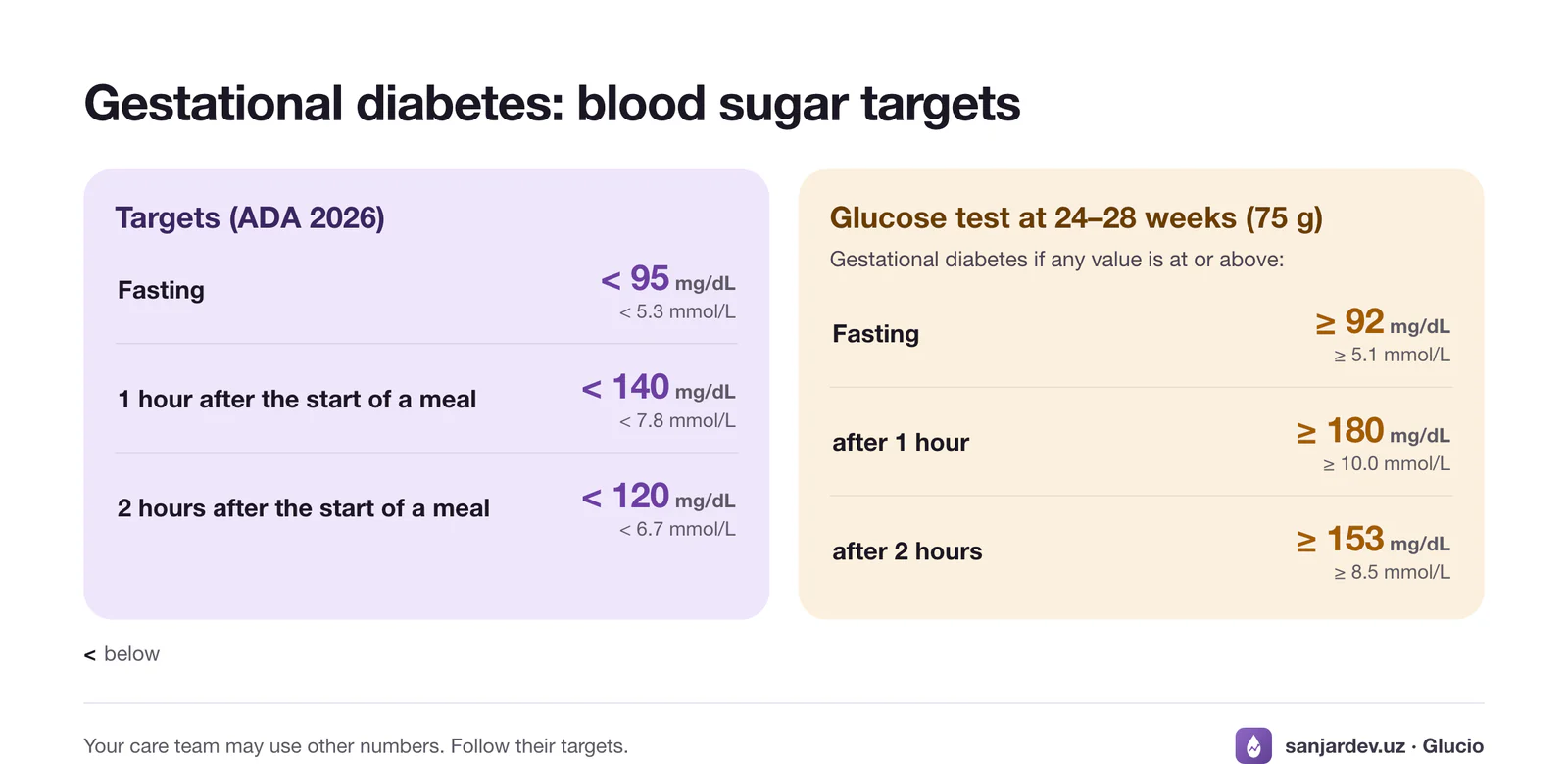
Short answer: with gestational diabetes, the American Diabetes Association (ADA) recommends keeping blood sugar below 95 mg/dL (5.3 mmol/L) fasting, and after meals either below 140 mg/dL (7.8 mmol/L) one hour or below 120 mg/dL (6.7 mmol/L) two hours after the start of the meal. Your care team decides whether you measure at one or two hours.
These targets are much lower than outside pregnancy. Here is why, how gestational diabetes is diagnosed and how to keep a record that helps your team.
Blood sugar targets in pregnancy
| Measurement | ADA 2026 target |
|---|---|
| Fasting | below 95 mg/dL (5.3 mmol/L) |
| 1 hour after the start of a meal | below 140 mg/dL (7.8 mmol/L) |
| 2 hours after the start of a meal | below 120 mg/dL (6.7 mmol/L) |
| A1C | below 6%, if it can be reached without lows |
If you are treated with insulin, your team may also give you lower limits — for example fasting 70–95 mg/dL (3.9–5.3 mmol/L) — because lows become possible.
Other countries may use slightly different numbers. In the United Kingdom, for example, NICE recommends fasting below 5.3 mmol/L, 1 hour below 7.8 mmol/L and 2 hours below 6.4 mmol/L. Follow the targets your own team gives you.
Why the targets are so low
In pregnancy, blood sugar is naturally lower than at other times. Glucose passes through the placenta to the baby; if your blood sugar stays high, the baby receives too much, may grow too large and can have low blood sugar after birth. Keeping your levels in target lowers these risks. Most women with gestational diabetes reach their targets with changes in food and activity; some need insulin or tablets.
How gestational diabetes is diagnosed
Gestational diabetes is usually checked between 24 and 28 weeks of pregnancy with a glucose tolerance test. The ADA standards describe two ways to do it.
In the one-step test, you drink 75 g of glucose after an overnight fast, and blood is taken fasting, after 1 hour and after 2 hours. Gestational diabetes is diagnosed if any one value is at or above:
| Time | Threshold |
|---|---|
| Fasting | 92 mg/dL (5.1 mmol/L) |
| 1 hour | 180 mg/dL (10.0 mmol/L) |
| 2 hours | 153 mg/dL (8.5 mmol/L) |
In the two-step test, common in the United States, you first drink 50 g of glucose without fasting, and blood is taken after 1 hour. If the result is 130–140 mg/dL (7.2–7.8 mmol/L) or higher — the cut-off depends on the clinic — a 3-hour test with 100 g of glucose follows, after an overnight fast. Gestational diabetes is diagnosed if at least two values are at or above 95 mg/dL (5.3 mmol/L) fasting, 180 mg/dL (10.0 mmol/L) after 1 hour, 155 mg/dL (8.6 mmol/L) after 2 hours and 140 mg/dL (7.8 mmol/L) after 3 hours.
Other countries use their own thresholds: in the United Kingdom, NICE diagnoses gestational diabetes at a fasting value of 5.6 mmol/L or a 2-hour value of 7.8 mmol/L or higher. A home glucometer is not used for the diagnosis.
How often and when to check
Many teams ask for four readings a day: fasting in the morning and one or two hours after each main meal. If you take insulin, you may be asked to measure before meals and at bedtime too.
- Count the time after a meal from the first bite, not from the end.
- Use the same interval every time — one hour or two hours, as agreed with your team.
- Wash and dry your hands before each reading: see how to check blood sugar with a glucometer.
- Write the meal next to the reading: it helps your team see which foods raise your blood sugar. Our printable blood sugar log has a column for each meal.
When to call your doctor or midwife
- several readings above target in a week, even if you feel well;
- blood sugar below 70 mg/dL (3.9 mmol/L), if you take insulin — treat it as explained in low blood sugar: what to do;
- nausea, vomiting or stomach pain with high readings: in pregnancy a dangerous condition called ketoacidosis can develop even when blood sugar is only moderately high, so get medical help promptly.
After the baby is born
Gestational diabetes usually goes away after birth, but it raises the chance of type 2 diabetes later in life. The ADA recommends a glucose test 4–12 weeks after birth and then a check for diabetes every 1–3 years for life. If you plan another pregnancy, tell your doctor beforehand.
How Glucio helps
Glucio, the blood sugar diary we develop for iPhone and Android, has a pregnancy mode: readings are shown against the ADA pregnancy targets, and after a reading before a meal Glucio offers a reminder to measure one hour later. The report for your team shows each day as a row — fasting, before and after breakfast, lunch and dinner, bedtime — with carbs and insulin next to the values. Glucio does not measure blood sugar and does not calculate insulin doses: discuss your results with your doctor or midwife.
Sources
- Standards of Care in Diabetes—2026, Section 15: Management of Diabetes in Pregnancy — American Diabetes Association
- Standards of Care in Diabetes—2026, Section 2: Diagnosis and Classification — American Diabetes Association
- Diabetes in pregnancy: management from preconception to the postnatal period (NG3) — NICE, United Kingdom
Written by Sanjar Jabborov, developer of Glucio. Checked against the ADA Standards of Care in Diabetes 2026 and NICE NG3. Updated on 13 November 2026. This article is for information only and does not replace advice from your doctor or midwife.