Job Completion Certificate Template (Free Sign-Off Form)
A free printable job completion certificate: what to put in it, how to hand over a finished job, how to record snags and what the client's signature means.
A job completion certificate, also called a completion report or a job sign-off sheet, is a one-page record the client signs when you hand over the work: what was done, on what date, which small fixes are still owed and how much is left to pay. Fill it in during a walk-through with the client, estimate in hand, and have both of you sign it before you take the final payment. Below are a free printable form, the handover steps and what the signature means.
Download the printable job completion form (PDF)
Why get the work signed off
The estimate says what you promised; the completion report says what you delivered and that the client accepted it. Five minutes at handover can save weeks of argument:
- It ends "you never finished". The client confirms that the listed work is done, on a date you both wrote down.
- It makes the balance a clear next step: work accepted, final payment, receipt.
- It turns complaints into a list. A touch-up becomes one line with a date, not a reason to hold back the whole balance.
- It dates your warranty, if you give one, and gives the client a record of exactly what was done.
The names vary: completion certificate, work completion form, sign-off sheet. The list of small items still to fix at the end is a punch list in the US and a snagging list in the UK. Large building contracts define their own milestones, such as substantial completion, but for a job you do alone or with a helper, one page signed by both of you is enough.
What goes in a job completion certificate
| Part | What to write | Why |
|---|---|---|
| Number and date | report No. 5, Nov 25, 2026 | you can both refer to it |
| You, the client, the job address | names, phone numbers, address | ties the report to one job |
| Estimate reference | estimate No. 12 | links the work to the agreed price |
| Work done | each item from the estimate with the quantity actually done, plus extra work the client approved | the client checks it line by line |
| Completion date | the day the work was finished | payment terms and your warranty run from it |
| Money | total, paid so far, balance due | the next step is clear |
| Statement | "I have checked the work listed above and accept it as complete, except for the remarks below, if any." | says what the signature means |
| Remarks | what is left to fix, and by when | stops vague complaints |
| Signatures | both of you, with names and the date | proof for both sides |
Photos are optional but worth taking: dated pictures of the finished work, from the same angles as your "before" shots.
In the sample job used across this series, completion report No. 5 for painting a living room and hallway refers to estimate No. 12, records the work as finished on Nov 25, 2026, and shows a total of $1,612.00, $483.60 paid as the deposit and $1,128.40 balance due. If a quantity changed on the way, write the actual quantity and the amount the client approved, so the report matches both the work and the bill.
The same page works beyond building trades: for a car or appliance repair, list what you found, replaced and tested, and have the client sign when they collect it.
The handover walk-through, step by step
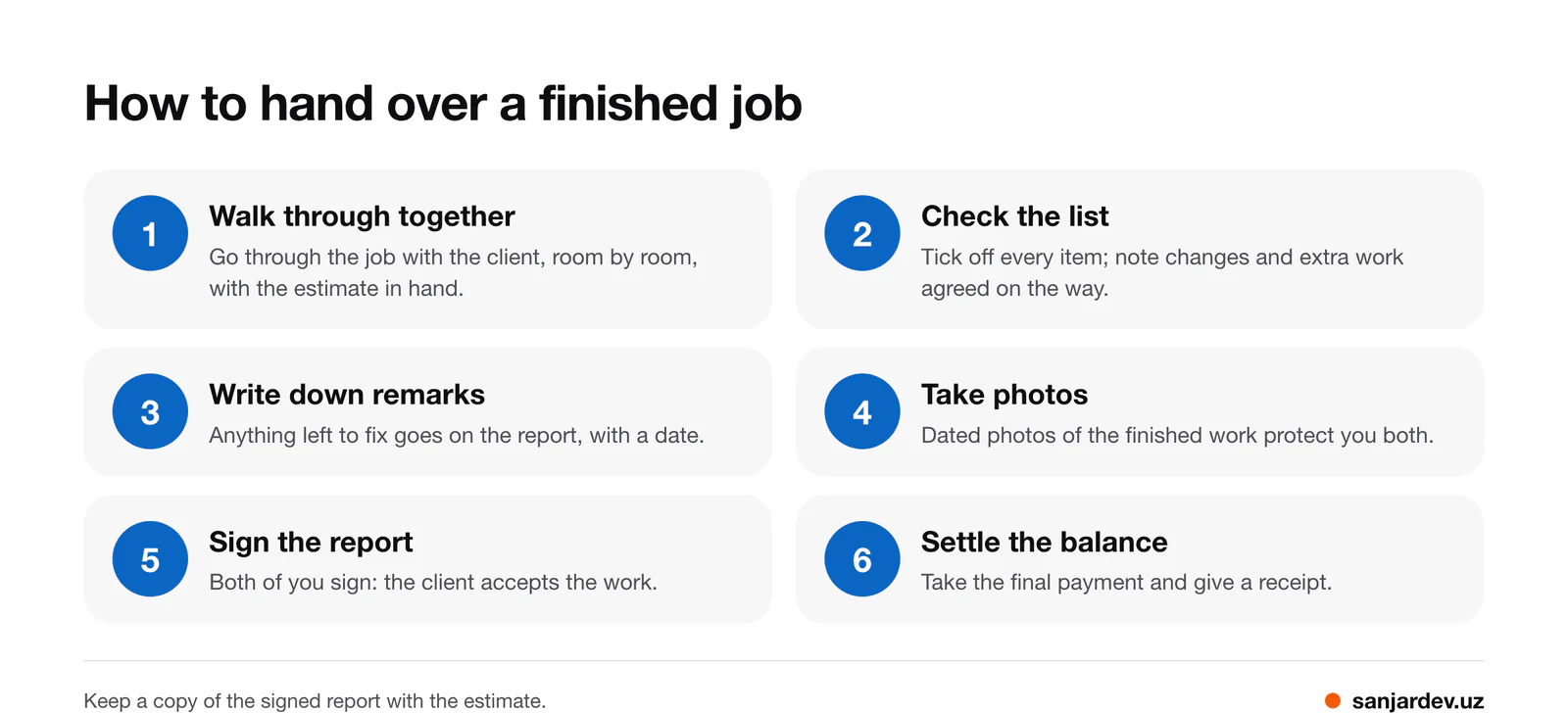
- Walk through together, room by room, with the estimate and any approved changes in hand. Book a time when the client can really look, in daylight if finish and color matter.
- Check the list. Tick off each item, show the extra work you agreed on the way, and explain anything you could not do and why.
- Write down remarks on the spot, each with what will be done and by when.
- Take photos of the finished work and of every remark.
- Sign the report, both of you, and give the client a copy: a carbon copy, a photo of the paper or a PDF in their messages.
- Settle the balance: take the final payment and give a receipt. Our payment receipt guide has a printable form for it.
Remarks and punch lists
A remark is something in the agreed work that is not right yet: paint missed in a corner, a dripping joint, a cracked tile. A change of mind (a different color) or new work (the stairs as well) is not a remark. It needs a new estimate or a written change with its own price.
Write each remark so that anyone can tell when it is fixed:
| Vague | Clear |
|---|---|
| Paint not great | Touch up two runs on the hallway wall, left of the front door, by Nov 28 |
| Fix the tiles later | Replace the cracked tile next to the tub with a spare from the client's box, by Dec 2 |
| Check the faucet | Tighten the kitchen faucet connection under the sink; the client confirms there is no drip after 24 hours |
Small remarks should not stop the sign-off: the client signs with the remarks listed. If they want to hold back part of the balance until a fix is done, agree on the amount and the date and write both on the report, rather than leaving the whole balance open for one touch-up. When a remark is fixed, ask the client to initial and date it on their copy, or to confirm by message.
Stage completions on longer jobs
On a kitchen, a bathroom or any job that runs for weeks, sign a short report at the end of each stage that has its own payment: demolition and rough-in, then tiling, then the final fit. Each report lists only that stage's work, and the last one closes the job. Our guide to deposits and stage payments shows how to set the schedule in the estimate.
Get work signed off before it is covered, such as pipes before the drywall or waterproofing before the tiles. Once it is hidden, your photos and the signed stage report are the only record of it.
When the client won't sign
Most refusals have a reason, and the reason decides the next step:
- There is a real defect. Write it as a remark with a date, and ask the client to sign with the remark.
- The client can't meet. Send the report and photos by message or email and ask for a written reply. "All looks good, thank you" in a message is a record too.
- They want more work first. Price the extra work separately; the finished work can be signed off now.
- They refuse without a reason. Stay calm, note the date, the walk-through you offered and what they said, and send the report in writing.
A missing signature does not undo the work, and the terms of your estimate decide when the balance is due. That is why "balance on completion" is clearer than "balance once you are satisfied".
What the client's signature means legally
United States. No federal law sets rules for accepting finished work: what the signature means comes from your contract and your state's law. Two points come up often:
- Signing on a screen. Under the federal E-SIGN Act, a signature or contract in a transaction affecting interstate commerce may not be denied legal effect solely because it is electronic (15 U.S.C. § 7001), although nobody is obliged to accept electronic signatures. Keep the signed PDF exactly as the client saw it.
- Lien waivers are separate documents. In California, anyone who helps improve a property and is not paid, subcontractors and suppliers included, may record a mechanics lien on it, and a waiver of those rights works only if it substantially follows one of the statutory forms in Civil Code §§ 8132, 8134, 8136 and 8138, as the Contractors State License Board explains. The unconditional waiver on final payment is enforceable against you once signed, even if you have not been paid, so sign it only after the money arrives. A completion report is not a lien waiver.
United Kingdom. When you work for a consumer, the Consumer Rights Act 2015 requires you to perform the service with reasonable care and skill (s. 49). If the work falls short, the client can require you to redo it at your cost, within a reasonable time and without significant inconvenience to them (s. 55), or, if that is impossible or you fail to, get a price reduction of up to the full price (s. 56). A contract term cannot exclude this liability (s. 57). So treat the sign-off as a record of what the client saw and accepted on the day, not as a waiver of their rights for defects that show up later. In England and Wales, a claim on a contract must generally be brought within six years (Limitation Act 1980, s. 5). An electronic signature is admissible as evidence in legal proceedings (Electronic Communications Act 2000, s. 7).
FAQ
What is a job completion certificate?
A short document the client signs at the end of a job to confirm that the listed work is complete and accepted, with any remaining fixes and the balance still due. It is also called a completion report or a sign-off sheet.
Who should sign a completion certificate?
The client who ordered the work, or someone they name in writing, such as a property manager, and you. If only a tenant or a relative is at home, ask the client to confirm by message.
What if the client finds a problem after signing?
Signing records what the client saw on the day. It does not stop them raising a defect that appears later, and in some places the law protects that right (see above). If the problem is your workmanship, fix it quickly; your dated photos help tell a new problem from your work.
What is a punch list or a snagging list?
The list of small defects and unfinished items found at the end of a job, such as paint marks or a loose handle: "punch list" in American English, "snagging list" in British English. On the completion certificate, they go under remarks, each with the date it will be fixed.
Is a completion certificate the same as an invoice?
No. A completion certificate confirms that the work was done and accepted, an invoice asks for payment and a receipt confirms payment. If your client or your tax rules require an invoice, issue it separately.
How Quotio helps
Quotio, the app we develop for Android, creates the completion report from the estimate in one tap: the items are copied over, you correct quantities and set the completion date, and the report shows the total, what has been paid and the balance due. On a long job, make one report per stage. The client signs with a finger on your screen, and the report carries the line "I confirm that the work has been completed in full and to my satisfaction." There is no separate remarks list, so fix small snags first or write them in the report's terms and notes. The PDF goes to the client's WhatsApp, and the receipt for the balance comes pre-filled. Free: 10 jobs a month with every document; Quotio Pro, a yearly subscription with 7 days free, adds photos and unlimited jobs. It does not make invoices. Quotio on Google Play
Sources
- Consumer Rights Act 2015, section 49 — legislation.gov.uk, 2015
- Consumer Rights Act 2015, section 55 — legislation.gov.uk, 2015
- Consumer Rights Act 2015, section 56 — legislation.gov.uk, 2015
- Consumer Rights Act 2015, section 57 — legislation.gov.uk, 2015
- Limitation Act 1980, section 5 — legislation.gov.uk, 1980
- Electronic Communications Act 2000, section 7 — legislation.gov.uk, 2000
- 15 U.S.C. § 7001, General rule of validity — U.S. Government Publishing Office, 2023
- Conditional and Unconditional Waiver and Release Forms — Contractors State License Board, California, 2026
- Unconditional Waiver and Release on Final Payment — Contractors State License Board, California, 2012
- Terms of Agreement: A Consumer Guide to Home Improvement Contracts — Contractors State License Board, California, 2024
Written by Sanjar Jabborov, developer of Quotio. General information, not legal or tax advice: check the current rules where you work. Updated on 15 November 2026.