How Much Deposit Should a Contractor Ask For? Limits and Rules
How much deposit to ask for a job, how to tie it to real costs, legal limits in some US states and the UK, refunds on cancellation, and stage payments.

There is no standard percentage. Ask for what you must spend or commit before the job starts, mainly materials ordered for that client, and never more than the law allows where you work: some places cap deposits on home jobs or forbid any payment before the contract is signed. Put the amount, the due date and what happens on cancellation in the estimate, and give a receipt when it is paid.
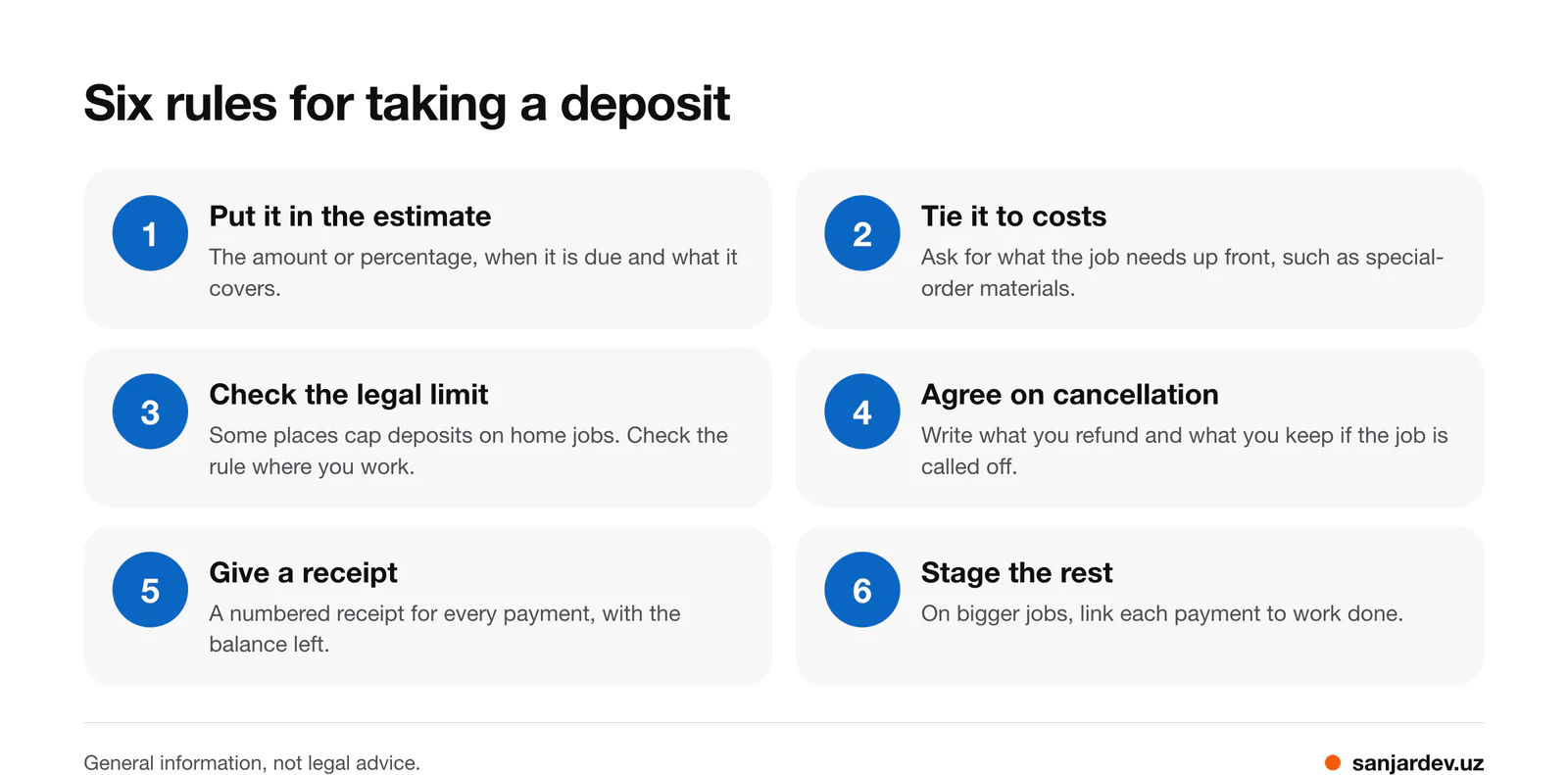
Why tradespeople ask for a deposit
A deposit does three jobs. It covers money you spend before the work starts, such as materials ordered for that client, equipment rental or a dumpster. It pays for the time you reserve, because holding a week for one client means turning other work down. And it shows commitment: a client who has paid something is less likely to vanish before the start date.
For the client, a deposit is a risk: they pay before seeing any work. Consumer agencies tell homeowners not to pay the full price up front and to be wary of anyone who wants cash only. A modest deposit, written into the estimate, explained and receipted, is what an honest tradesperson looks like.
Not every job needs one. For a repair you finish in a day, or a job where the client buys the materials, payment on completion is simpler.
How much deposit to ask for
Start from your costs, not from a percentage:
- Add up what you pay before day one: materials, especially special orders you can't return, rentals, permits and disposal. Working out the price itself is covered in how to price a job.
- Look at the length of the job. For a day or two of work, a deposit for materials is enough. For several weeks, keep the deposit modest and agree stage payments for the rest.
- Check the legal limit where you work (see below). It can cap the deposit or set when you may take it.
- Weigh the risk. A large special order for a new client justifies more than a repaint for a regular one, but use the same rule for everyone, so a deposit never feels personal.
- Write it as an amount, or a percentage with the amount next to it, and a due date.
The sample estimate used in this series totals $1,612.00, of which paint and materials are $245.00. A deposit of $245.00 would cover the materials and nothing else. The sample asks 30%, which is $483.60: it covers the materials, part of the labor and the reserved days, and leaves $1,128.40 for completion. Either can be justified where the law allows it, because the client can see what the money pays for.
Legal limits on deposits
United States. There is no single national rule. The FTC tells homeowners that some states limit how much a contractor can ask for as a down payment, and to check with their state or local consumer agency. Four examples of state rules for home improvement work:
| State | Rule | Source |
|---|---|---|
| California | down payment of at most $1,000 or 10% of the contract price, whichever is less, with no exception for special-order materials; after that, payments may not run ahead of the work done or the materials delivered | Business and Professions Code §§ 7159, 7159.5, as the Contractors State License Board explains them |
| Maryland | no payment before the contract is signed; a deposit of at most one-third of the contract price | Business Regulation § 8-617 |
| Pennsylvania | no payment before the contract is signed; on contracts over $5,000, a deposit of at most one-third of the price, or one-third plus the special-order materials named in the contract | Home Improvement Consumer Protection Act, s. 9 |
| Florida | an initial payment of more than 10% on residential work obliges you to apply for permits within 30 days and to start within 90 days after they are issued, unless you have just cause or the client agrees in writing to longer | Florida Statutes § 489.126 |
If the sample painting job were a California home improvement contract, its down payment could be at most $161.20, which is 10% of $1,612.00, rather than the $483.60 the sample asks; further payments could only follow the work done and the materials delivered. Other states have their own rules, so check with your state's contractor board or consumer protection office before you fix a deposit.
United Kingdom. No statute sets a maximum percentage for deposits on building or repair work; the limits come from consumer advice and fairness rules. Citizens Advice tells clients to pay in stages, to push any deposit down as much as possible and not agree to more than 25%, and to avoid traders who want everything up front. Under the Consumer Rights Act 2015, an unfair term does not bind a consumer (s. 62), and the terms that may be unfair include letting a trader keep money paid when the consumer cancels without equivalent compensation when the trader cancels, and charging a disproportionately high sum for canceling (Sch. 2, paras 4 and 5).
What happens to the deposit if the job is canceled
In everyday English, deposit, down payment and advance payment often mean the same thing: money paid before the work. What matters is what you agreed. Write in the estimate whether the money is part of the price that comes back, less the costs you name, if the job does not go ahead, or a booking fee the client loses by canceling late.
United States. If the client agreed to the job at their home, the FTC's Cooling-Off Rule usually lets them cancel until midnight of the third business day, and you must refund all payments within 10 business days of their notice (16 CFR Part 429; our estimate guide explains who is covered). For home improvement contracts not made at your place of business, California gives three business days, or five for clients aged 65 or older, with the money returned within 10 days. After that, whether you may keep any of the deposit depends on your contract and your state's law.
United Kingdom. For a contract made at the client's home, the client has 14 days to cancel (Consumer Contracts Regulations 2013, reg. 30), and you must refund everything within 14 days of being told, by the same means of payment and without a fee (reg. 34). If they asked you on paper or by email to start within those 14 days, they pay for the work done up to the cancellation, in proportion to the whole job, provided you gave them the cancellation information (reg. 36). After that, Citizens Advice tells clients that a trader may keep some or all of a deposit to cover their losses. The Competition and Markets Authority's guidance adds that making a substantial prepayment entirely non-refundable is more likely to be unfair, while a genuine deposit may be kept in full if it works as a binding reservation, the client is told clearly when it is not refundable, and it is normally no more than a small percentage of the price (CMA37, paras 6.60–6.62).
Stage payments on bigger jobs
On a job that runs for weeks, a small deposit followed by payments for stages the client can see is fairer to both sides. An example for a $9,000 bathroom remodel:
| Payment | Due when | Example amount |
|---|---|---|
| Deposit | the contract is signed | $900.00 |
| Stage 1 | demolition and the new plumbing and wiring are done and checked | $3,600.00 |
| Stage 2 | the tiling is finished | $3,600.00 |
| Final | the job is handed over and signed off | $900.00 |
Describe each stage in the estimate the way you will check it, sign a short completion report at the end of each stage and give a receipt for each payment. Don't leave most of the price for the end: the last payment is the one you wait for after the work is finished.
Putting the deposit in writing
Put the deposit in the estimate's terms, so the client sees it before signing. A wording you can adapt:
Deposit: [amount] ([percent] of the total), due [date], before work starts. It pays for [materials ordered for your job] and reserves your dates.
If the job is canceled: if you cancel after we have ordered materials, we keep the cost of materials we cannot return and refund the rest within [number] days. If we cancel, we refund the deposit in full.
Balance: [amount], due on completion, or by the stages listed above.
Check it against the legal limits where you work before you use it.
Red flags for clients
Careful clients watch for these warning signs, and an honest tradesperson can avoid every one of them:
- asking for all or most of the price before any work;
- cash only, or payment into someone else's account;
- no written estimate, or blanks left in it;
- pressure to pay today to "lock in" the price;
- no receipt for the deposit.
If a job really needs a large deposit, for custom cabinets for example, explain it in the estimate, show the supplier's order, or let the client pay the supplier directly.
FAQ
What is a reasonable deposit for a contractor?
One you can explain: enough to cover the materials you buy for that job and the time you reserve, within any legal limit where you work. On a long job, a modest deposit plus stage payments.
Can a contractor keep my deposit if I cancel?
It depends on when the client cancels, what the contract says and local law. Within a legal cooling-off period, the deposit usually has to be refunded; later, a tradesperson may be able to keep what covers real losses, such as materials that cannot be returned (see above).
Is it normal for a builder to ask for a deposit?
Yes, especially when materials have to be ordered or the job runs for weeks. What matters is that it is in writing, reasonable for the job, within any legal limit and receipted.
Can a contractor ask for 50% up front?
Where the law caps deposits, often not (see the limits above). Elsewhere it is a matter of agreement, but half the price before any work asks for a lot of trust: tie the deposit to real costs and use stage payments for the rest.
What is the difference between a deposit and a down payment?
In everyday use, very little: both are money paid before the work. Legally, the difference is what happens if the job is canceled, so write down whether the money is refundable and on what terms.
How Quotio helps
Quotio, the app we develop for Android, puts the deposit on the estimate as a percentage or an amount and shows it on the PDF as "Deposit due"; the job shows Awaiting deposit until it is paid. Record payment fills in a receipt with the deposit amount and "Deposit for estimate #12", and every receipt shows the balance left after it. Later, completion reports, one per stage if you need, and receipts for the rest take the job to Paid. Quotio does not check local deposit limits: you set the amount. Free: 10 jobs a month with every document; Quotio Pro is a yearly subscription with 7 days free. It makes estimates, completion reports and receipts, not invoices. Quotio on Google Play
Sources
- What is a Contract? — Contractors State License Board, California, 2026
- CSLB Reminds Contractors of Progress Payment Restrictions — Contractors State License Board, California, 2022
- Terms of Agreement: A Consumer Guide to Home Improvement Contracts — Contractors State License Board, California, 2024
- Business Regulation § 8-617 — Maryland General Assembly, 2026
- Home Improvement Consumer Protection Act, Act 132 of 2008 — Pennsylvania General Assembly, 2011
- Florida Statutes § 489.126, Moneys received by contractors — The Florida Senate, 2026
- How To Avoid a Home Improvement Scam — Federal Trade Commission, 2022
- 16 CFR Part 429, Cooling-Off Period for Sales Made at Homes or at Certain Other Locations — Electronic Code of Federal Regulations, 2026
- Before you get work done on your home — Citizens Advice, 2026
- Cancelling building or decorating work — Citizens Advice, 2026
- The Consumer Contracts (Information, Cancellation and Additional Charges) Regulations 2013 — legislation.gov.uk, 2013
- Consumer Rights Act 2015, section 62 — legislation.gov.uk, 2015
- Consumer Rights Act 2015, Schedule 2 — legislation.gov.uk, 2015
- Unfair contract terms (CMA37) — Competition and Markets Authority, 2026
Written by Sanjar Jabborov, developer of Quotio. General information, not legal or tax advice: check the current rules where you work. Updated on 15 November 2026.