Job Estimate Template: How to Write One (Free PDF and Excel)
A free job estimate template as a printable PDF and an Excel file with formulas, and how to write an estimate step by step, from the site visit to the signature.
A job estimate is the written price you give a client before you start one specific job: who you both are, each piece of work and material with its quantity and price, the total, how long the price holds and your terms. Write it after you have seen and measured the job, itemize it, and get it signed before any work begins. Below are a free printable form and an Excel template that does the math.
Estimate, quote or invoice?
Clients use these words loosely, so it helps to know what each document does.
| Document | When | What it does |
|---|---|---|
| Estimate | before the job | proposes a price for the work described; the usual word in American English |
| Quote, quotation | before the job | the usual word in British English, where it normally means a fixed price and "estimate" an approximate one |
| Invoice | after the job or a stage | asks for payment for work done; in many countries also a tax document with content set by law |
| Receipt | when you are paid | confirms that a payment was received |
Whatever you call it, the estimate is where the job gets defined. It is not an invoice and does not replace one: if your client or your tax rules need an invoice, issue it separately.
What to put in an estimate
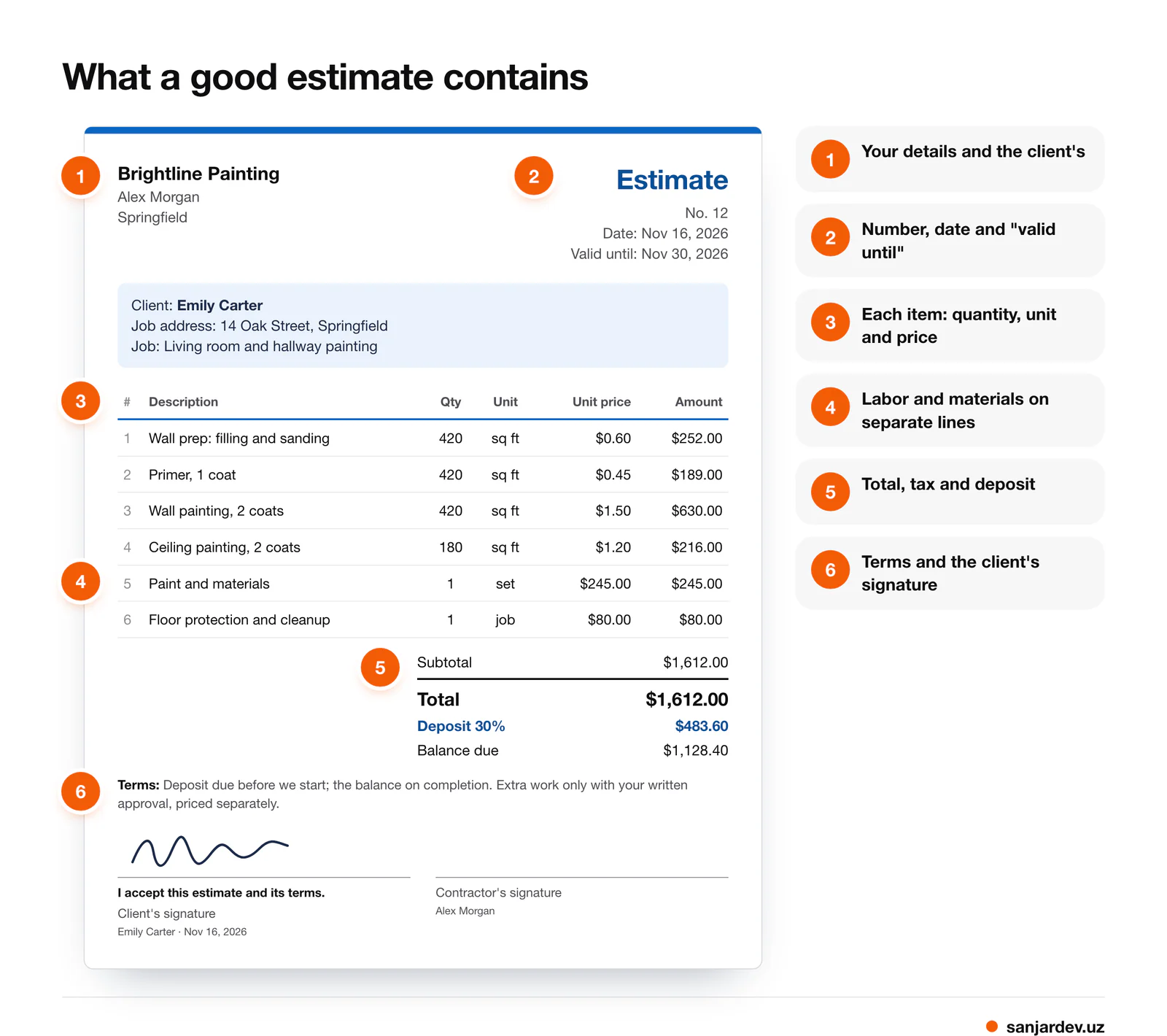
A good estimate answers the questions the client would otherwise call you about. The six parts marked on the sample:
- Your details and the client's: business name, phone and email; the client's name, phone and the job address; a license number where your trade requires one.
- A number, the date and "valid until". The number lets you both refer to "estimate No. 12"; the validity date tells the client how long they have to decide and protects you if material prices change.
- Each item with quantity, unit and price. "Wall painting, 2 coats: 420 sq ft × $1.50 = $630.00" is clear; "Painting, $1,600" invites an argument about what was included. Use the units you measure in: square feet or square meters, linear feet, pieces, hours or one item for the whole job.
- Labor and materials on separate lines, with the product or grade you priced. If the client decides to buy the paint, you change one line, not the whole estimate.
- The totals: subtotal, any discount, tax where it applies, total, deposit and balance, with the arithmetic shown.
- Terms and signatures: start date and duration, when each payment is due, what is excluded and how extra work is handled, then space for both signatures and dates.
The sample, estimate No. 12 of Nov 16, 2026, has five labor lines and one line for paint and materials at $245.00. The subtotal is $1,612.00 and, with no sales tax in the example, so is the total. A 30% deposit means $483.60 before work starts and $1,128.40 on completion; the price holds until Nov 30, 2026. The 30% is only an example: some places limit deposits on home jobs, as our guide on how much deposit to ask for explains.
How to write an estimate, step by step
- See the job before you price it. Measure, take photos and note what changes the work: cracked plaster, furniture to move, parking, the hours you may work. If you price from the client's photos, say so in the terms.
- Ask what the client wants: colors and finish, who buys the materials, the deadline. The answers become your item descriptions.
- Break the job into items the client can picture (prep, primer, two coats on the walls, ceiling, trim), each with a quantity and a unit.
- Price each item from your price list: labor by the hour or by the unit, materials with waste and markup. How to arrive at those numbers is covered in how to price a job.
- Write the terms: deposit and payment schedule, start date and duration, exclusions, and a line such as "Extra work only with your written approval, priced separately."
- Set the validity date: long enough for the client to decide, short enough that your prices still hold. The sample allows two weeks.
- Send it while the visit is fresh, the same day or the next, and go through a large job with the client by phone.
- Get it signed before you start. If anything changes later, write the change and its price down and get it approved the same way. When the job is done, a job completion report lets the client confirm the work against the estimate.
How to use the free templates
The printable form (PDF) is one Letter-size page with your details, the client, item lines, totals, terms and two signature lines. Fill one in at the client's and photograph it once it is signed, so you both have a copy.
The Excel template has three sheets. On Estimate, each line multiplies quantity by price, and formulas add the subtotal, discount, tax, total, deposit and balance; set the three percentages or leave them at 0. Price list holds your usual items to copy from. Save a copy for every client, then print it or save it as a PDF. To use it in Google Sheets, upload the file to Google Drive and double-click it: Google's help says Drive opens Office files for editing.
A paper form is enough for a few estimates a month; the spreadsheet pays off when estimates have many lines or you reuse the same prices.
When an estimate must be written, binds you or can be canceled
United States. Rules depend on the state and the trade. California, for example, requires car repair shops to give an estimate of parts and labor before repairing a vehicle and to get the customer's authorization before charging more (Business and Professions Code § 9884.9), and requires a written contract for home improvement projects over $500, with changes made by a signed change order (§ 7159).
If a household client agrees to the job at their home, the FTC's Cooling-Off Rule (16 CFR Part 429) can apply even when they invited you: for $25 or more, they may cancel until midnight of the third business day (Sundays and federal holidays don't count). You must give them the contract with a cancellation statement next to their signature and two copies of a cancellation notice, tell them about the right, and refund within 10 business days if they cancel. The Rule does not cover a genuine emergency where the client gives you a signed, handwritten waiver, or repairs they asked you to do on their personal property rather than the house. States may add more: in California, clients aged 65 or older get five business days for home improvement work.
United Kingdom. Citizens Advice tells clients that a quote is a fixed price and an estimate "just a rough guess". An accepted quote binds you even if it was never written down, and you can charge more only for extra work the client asks for or agrees to, or to correct a genuine mistake. Anything you say or write about the service that the client takes into account becomes part of the contract (Consumer Rights Act 2015, s. 50); where no price was fixed, they pay a reasonable price (s. 51).
A contract with a consumer made at their home is an off-premises contract under the Consumer Contracts Regulations 2013. Before it binds them, give the client on paper (or by email, if they agree) your details, the total price including taxes, the cancellation terms and a cancellation form (reg. 10). They have 14 days to cancel (reg. 30), or up to 12 months longer if you leave the cancellation information out (reg. 31), which is also an offense (reg. 19). Start within the 14 days only at their request on paper or by email; if they then cancel, they pay for the work done so far, provided you gave them the cancellation information (reg. 36). The right to cancel does not apply to urgent repairs they called you out for, except extra work sold on that visit (reg. 28), or to contracts of £42 or less (reg. 27).
Common mistakes
| Mistake | What goes wrong | Do this instead |
|---|---|---|
| one line such as "Paint living room, $1,600" | you and the client remember different work | list every item with its quantity |
| no "valid until" date | the client says yes months later, after prices rose | always write a date |
| materials not specified | the client expects a better product than you priced | name the brand, the grade or an allowance |
| nothing about extra work | arguments over the final bill | agree on extra work and its price in writing first |
| starting before it is signed | no proof of what was agreed | get a signature and a date first |
| changes agreed only by phone | the bill no longer matches the estimate | write the change down and have it approved |
| totals worked out by hand | a sum that doesn't add up looks careless | let a template or an app do the math |
FAQ
What should be included in an estimate?
Both parties' details and the job address, a number, the date and a "valid until" date, itemized labor and materials with quantities and prices, the totals with any discount, tax and deposit, and terms with space for signatures. The free form and template above have all of them.
Is a signed estimate a contract?
Once accepted, an estimate usually becomes the basis of your agreement. How firmly it binds you and what you may charge beyond it depend on its wording and on local law (see the rules above), so say clearly whether the price is fixed or approximate.
Can a contractor charge more than the estimate?
Treat the estimate as the price unless the client agrees to a change. If you find extra work or the client asks for more, tell them what it adds and what it costs, and get their approval in writing before you do it.
How long is an estimate good for?
Until the "valid until" date on it. There is no standard period: give the client time to decide, and end it before your costs can change much. The sample allows two weeks.
Should contractors charge for estimates?
Many tradespeople estimate for free, because that is how they win work. Some charge when the visit means a long drive or the job needs design or diagnostic work, and take the fee off the price if the client goes ahead. Either way, say so before you visit.
How Quotio helps
Quotio, the app we develop for Android, builds this estimate on your phone at the client's. Pick labor and materials from your own price list (it can start from ready items for 10 trades), type quantities on a big keypad, and it adds the discount, tax, deposit and a "valid until" date. The client signs with a finger on the screen, the estimate is marked approved with their name, date and time, and the PDF goes to their WhatsApp chat or any other app; for a UK business it is titled Quote. The same job later gets its completion report and receipts. Free: 10 jobs a month, each with all its documents, and up to 30 of your own price list items. Quotio Pro, a yearly subscription with 7 days free, adds unlimited jobs, your logo and photos. It does not make invoices. Quotio on Google Play
Sources
- 16 CFR Part 429, Rule Concerning Cooling-Off Period for Sales Made at Homes or at Certain Other Locations — Electronic Code of Federal Regulations, 2026
- Write It Right: Documentation and authorization requirements for automotive repair dealers — California Bureau of Automotive Repair, 2026
- What is a Contract? — Contractors State License Board, California, 2026
- Terms of Agreement: A Consumer Guide to Home Improvement Contracts — Contractors State License Board, California, 2024
- Before you get building work done — Citizens Advice, 2026
- Consumer Rights Act 2015, Part 1, Chapter 4: Services — legislation.gov.uk, 2015
- The Consumer Contracts (Information, Cancellation and Additional Charges) Regulations 2013 — legislation.gov.uk, 2013
- Work with Office files — Google Docs Editors Help, 2026
Written by Sanjar Jabborov, developer of Quotio. General information, not legal or tax advice: check the current rules where you work. Updated on 15 November 2026.