How to Write a Brief for a Website, Bot or App (Free Template)
A free website brief template (PDF) for sites, Telegram bots and apps: what to include, how much detail is enough and how a good brief saves money.
Short answer: A brief is a short document, one or two pages, that says what you want to build, for whom and why. It lets a developer give you an accurate estimate instead of a guess and protects you from paying for work that was understood differently. Below is what to put in it, real examples of how one line changes a project, and a free template you can print and fill in.
What a brief is and why it saves money
A brief is not a technical specification. You don't need programming terms to write one: you describe your business, your customers and what the project should do for them. The technical details are worked out together later.
A good brief saves money in three ways:
- The estimate is accurate. Without details, a developer either adds a margin for the unknown or quotes low, and the price grows later. With a brief, the estimate covers what you actually need.
- Misunderstandings surface early. A difference in expectations found in a brief costs one sentence to fix. Found after the code is written, it can cost a whole stage of work.
- Developers can be compared fairly. Send the same brief to everyone you are considering, and you compare like with like. The questions each one asks back also tell you a lot: see how to choose a developer.
What to put in a brief
Eight parts cover almost any website, Telegram bot, Mini App (a web app that opens inside Telegram), mobile app or CRM (a system for customers, orders and the team's work).
| Part | What to write | Why it matters |
|---|---|---|
| Goal | The problem to solve and the action you want from users: order, book, pay, call | It defines what "done" means |
| Audience | Who your customers are, which devices and languages they use | It changes the choice of platform and design |
| Features | What the first version must have, and what can wait | The main driver of price and time |
| Examples | Two or three sites, bots or apps you like, and what exactly you like | Saves hours of explaining a style |
| Content | Who writes the texts and takes the photos; how many products or pages | Often the real cause of delays |
| Integrations | Payments, delivery, maps, CRM, accounting, SMS | Each one is separate work with its own rules |
| Deadline | The date, and what it depends on: a season, an event, a launch | Decides what fits into the first version |
| Budget range | An honest range you are comfortable with | Lets the developer suggest the version that fits |
If you are not sure yet whether you need a site, a bot or an app, write the goal and the audience anyway: that is usually enough to decide. The guide on where to start selling online compares the options.
How one line in a brief changes the project
Real examples from my work show why the "boring" parts of a brief matter.
The audience decided the type of bot. Meatline Tashkent sells sausages and meat delicacies through Telegram. Its customers are people of different ages, and many find familiar chat buttons easier than a web interface, so the shop became a classic chat bot rather than a Mini App; such a bot also works reliably on weak mobile internet.
Another problem in the same task, couriers losing time because customers typed addresses in free form, led to a location button: the bot turns the customer's location into a street address through Yandex Maps and asks the customer to confirm it.
Two kinds of customers meant two sign-up flows. Primefoods.uz sells both to private buyers and to companies. That one fact required separate registration: quick for individuals, and a form with company details for business customers, so they get special terms and correct documents.
"Let customers estimate the price" became a calculator. For imzonamangan.uz, the site had to do more than present the products: customers choose a window or door type, its size and materials, and see the price calculated in real time. The site also works in three languages, Russian, Uzbek and English, which is another single line in a brief that changes the amount of work.
How much detail is enough
One or two pages is plenty. A few rules make them useful:
- Describe the problem, not the technology. "Customers should be able to pay by card without calling us" is better than the name of a programming framework. Choosing the technology is the developer's job.
- Separate "must have" from "nice to have". A first version with the essentials launches sooner and costs less; the rest can follow once real customers have used it.
- "I don't know" is an answer. Leave the question open, and it will be discussed. A guess written down as a requirement is worse than a blank.
- Attach links and screenshots. One screenshot with "like this, in our colors" explains more than a paragraph.
- Write in your own language. Clarity matters more than style.
Why it's worth naming a budget
Many people hide their budget, afraid the price will be fitted to it. In practice, the same goal can be reached in very different ways: a one-page landing page, a corporate site, or a full online store with a cart and payments. Knowing your range, a developer can suggest the version that fits and say honestly what it leaves out.
For orientation, my starting prices are $200 for a landing page or a Telegram bot and $500 for an online store; what makes a project cost more is explained in the cost guide.
The free brief template
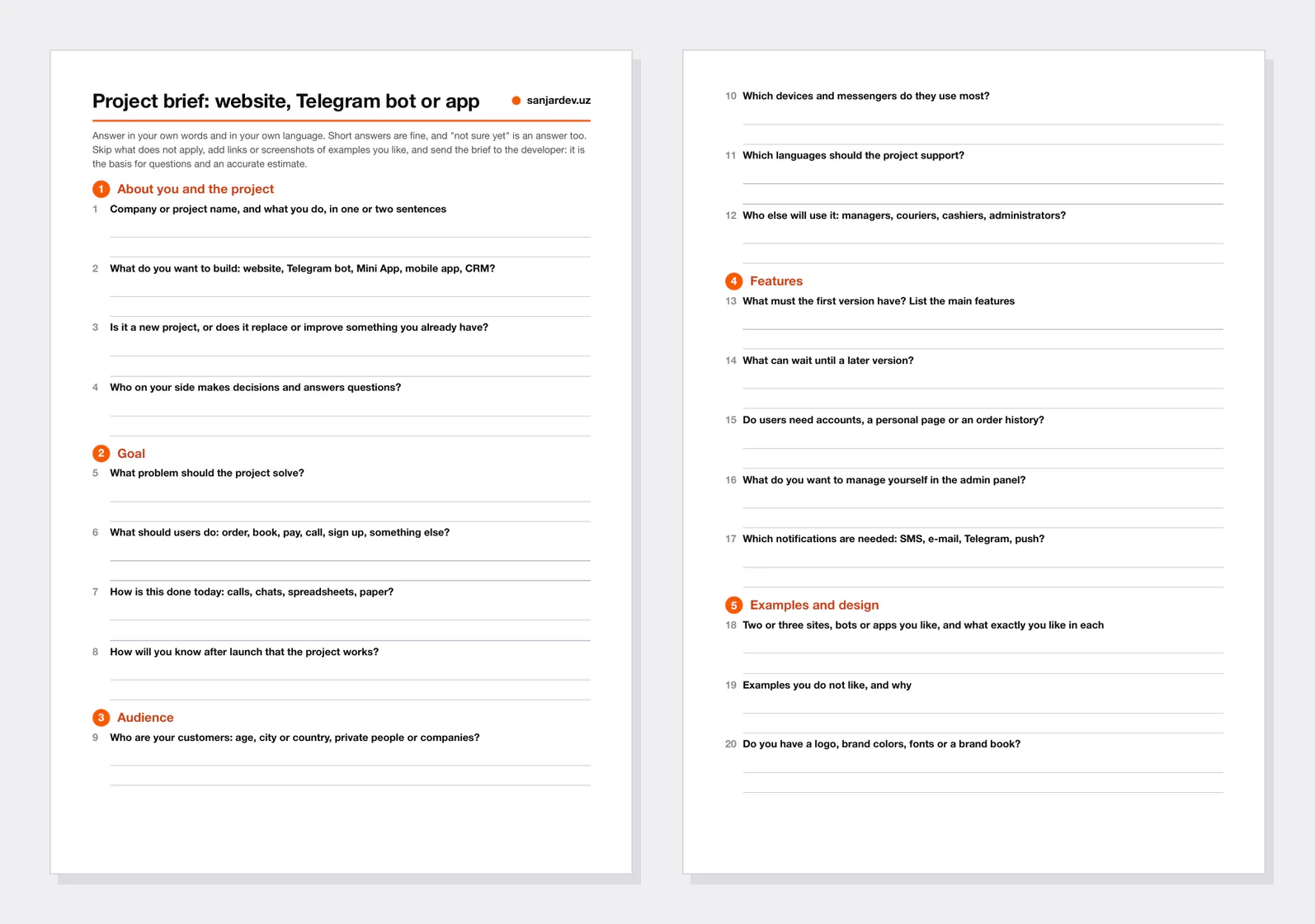
The template covers the same ground in eight short sections, from "About you and the project" to "Deadline, budget and support", with a few short questions in each. Download the brief template (PDF), then:
- Print it, or copy the questions into a message or a document.
- Answer in your own words, and skip what doesn't apply.
- Add links and screenshots of examples you like.
- Send it to the developers you are considering.
What happens after you send it
I read the brief and reply with questions, then with an estimate: the scope, the stages and the price, as a fixed price or time and materials. From there, the work follows the stages described in how a development project works.
Frequently asked questions
Do I need a technical specification instead?
No. A brief is enough to start. If the project needs a detailed specification, it is written together during the discussion and the prototype stage, once the solution is clear.
Is a brief the same as a proposal?
No. The brief comes from you: your goals and wishes. The proposal, or estimate, is the developer's answer to it: what will be built, in which stages and for what price. In larger companies, a more formal version of the brief is called a request for proposal (RFP).
What if I can't answer most of the questions?
Answer the goal and the audience, and send it as it is. The rest can be filled in during the first conversation.
Is the same template suitable for a website and for a bot?
Yes. The questions are the same for any digital project, and if you are choosing between a site, a bot and an app, the answers help decide where to start.
Discuss your project
Send me your brief, filled in completely or only partly, on Telegram, WhatsApp or by e-mail. If you'd rather not fill in a form, describe the task in a few sentences, and I will reply with questions and an estimate. You can write in your own language; calls are possible in Uzbek, Russian, Turkish or English.
Sanjar Jabborov — fullstack developer, Tashkent. Updated on 13 November 2026.