Road Signs of Uzbekistan with Meanings (Printable PDF)
The seven groups of road signs in Uzbekistan with their meanings, the signs learners confuse most, and a free printable PDF of 30 key signs by their Uzbek numbers.
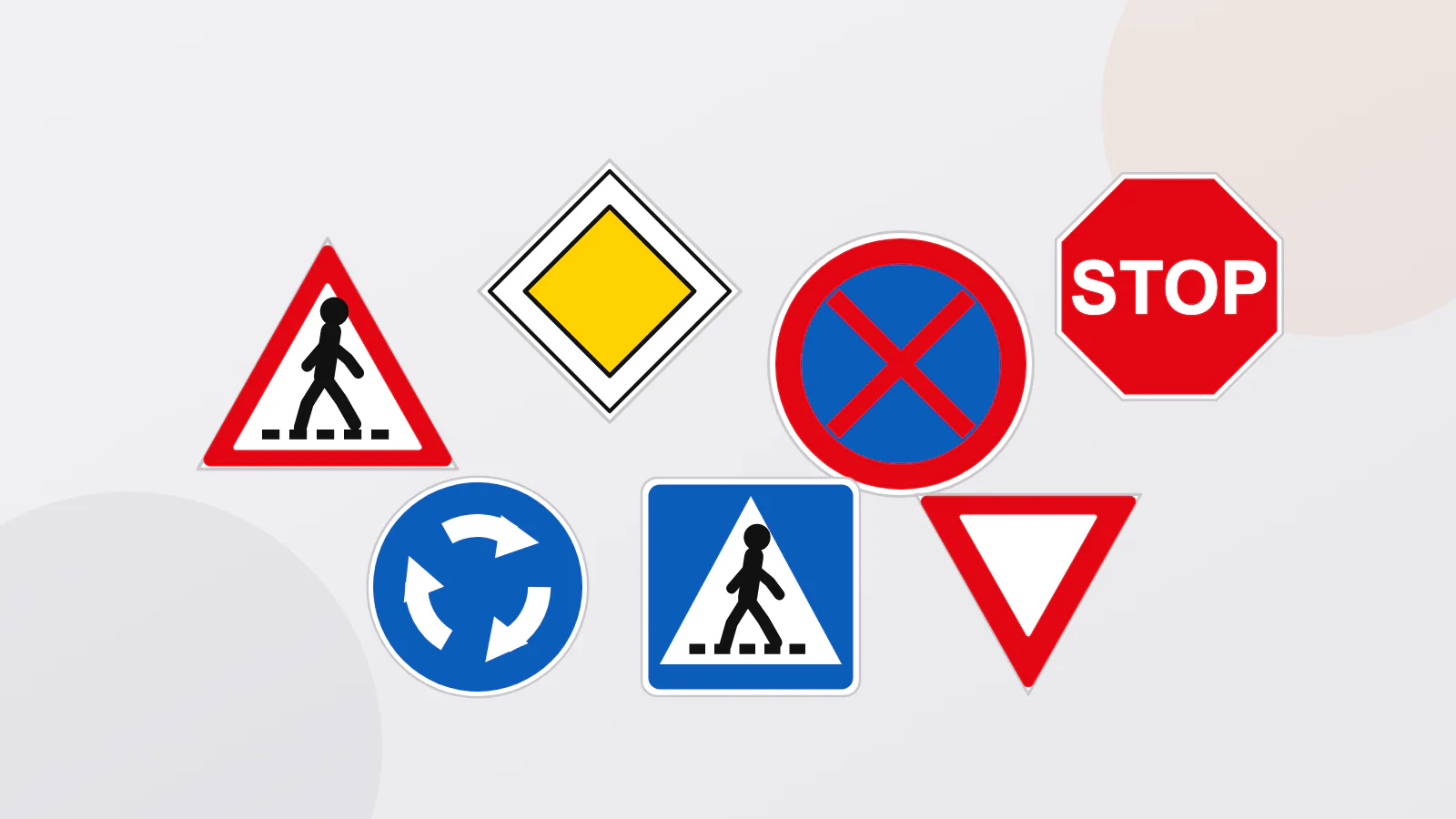
Uzbekistan's Road Traffic Rules divide road signs into seven groups: warning, priority, prohibitory, mandatory, information and direction signs, service signs, and additional information plates. Every sign has a number from Appendix 1 to the rules, and these numbers can differ from other countries' lists, including Russia's. Below are the groups, how long a sign keeps working, the pairs learners confuse most, and a printable sheet of 30 key signs.
The seven groups of road signs
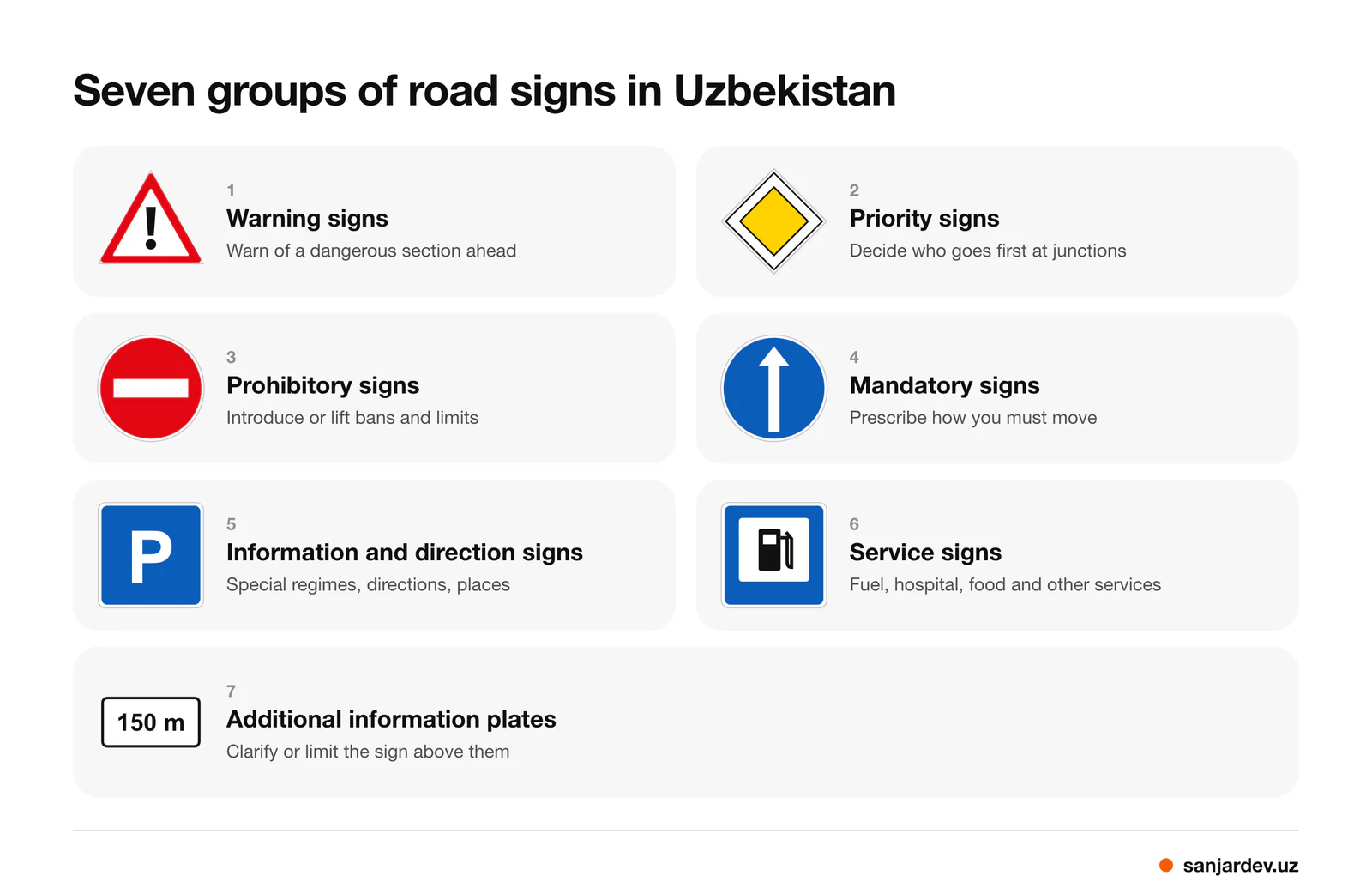
The groups follow Appendix 1 to the Road Traffic Rules, approved by Cabinet of Ministers Resolution No. 172 of 12 April 2022. The appendix gives each sign's number, name and picture; the descriptions of shapes below are ours, based on those pictures.
| No. | Group | Uzbek name | What the signs do | How to recognize them |
|---|---|---|---|---|
| 1 | Warning | Ogohlantiruvchi belgilar | Warn of a dangerous section ahead | Triangle with a red border, point up |
| 2 | Priority | Imtiyoz belgilari | Decide who goes first at intersections and narrow sections | Own shapes: yellow diamond (2.1), inverted triangle (2.4), red octagon with STOP (2.5) |
| 3 | Prohibitory | Taqiqlovchi belgilar | Introduce or lift bans and limits | Circle with a red border; no stopping and no parking have a blue field |
| 4 | Mandatory | Buyuruvchi belgilar | Prescribe how you must move | Blue circle with white symbols |
| 5 | Information and direction | Axborot-koʻrsatgich belgilari | Special regimes such as one-way roads, motorways and parking, plus directions and places | Mostly blue, green or white rectangles and squares |
| 6 | Service | Servis belgilari | Show where services are: fuel, hospital, food, toilets | Blue rectangle with a white field and a symbol |
| 7 | Additional information | Qoʻshimcha axborot belgilari | Clarify or limit the sign they are placed under | Small white plates under the main sign |
Unlike some other countries' rules, Uzbekistan has no separate group for "special regulation" signs: one-way roads, motorways, parking places and pedestrian crossings are all in group 5.
Three general rules from the end of the appendix are worth remembering. Temporary signs are yellow, and if a temporary sign contradicts a permanent one, you follow the temporary sign. Electronic signs installed in the proper way have the same force as ordinary ones. Warning signs stand 50–100 m before the danger in populated areas and 150–300 m before it outside them.
How long a sign keeps working
Knowing where a sign stops working matters as much as knowing what it means. The appendix to the rules sets this out:
- Zone signs (3.16, 3.20, 3.22, 3.24, 3.26–3.30) work from the sign to the nearest intersection after it. With no intersection, they work to the end of the populated area.
- An exit from a yard or a field road is not an intersection: it does not end the zone.
- A speed limit sign 3.24 placed before a populated area keeps working until the sign marking the start of that area.
- A zone can end earlier with an "end" sign (3.21, 3.23, 3.25), with a plate showing the length of the zone, or with a new 3.24 sign showing another speed.
- No stopping and no parking signs (3.27–3.30) apply only to the side of the road where they stand.
- Mandatory direction signs 4.1.1–4.1.6 apply to the intersection in front of which they stand.
Signs that are easy to confuse
No stopping (3.27) and No parking (3.28)
The difference starts with the definitions in clause 6 of the rules: stopping means standing still for up to 10 minutes, while parking means standing still deliberately for more than 10 minutes for reasons other than letting passengers in or out or loading. Sign 3.27 bans both; sign 3.28 bans only parking, so you may still stop briefly. Signs 3.29 and 3.30 ban parking on odd and even days of the month; when they stand on opposite sides of the road, parking on both sides is allowed from 19:00 to 21:00, the time for moving cars across.
There are exceptions written into the appendix. Taxis not on a fixed route may stop under 3.27 to drop off or pick up passengers, and taxis with the meter on are not bound by 3.28–3.30. Drivers with a disability and the "disabled driver" sign on the car may ignore 3.28, and under plate 7.18 they may also stop under 3.27. What breaking these signs costs is in our table of traffic fines.
Main road (2.1), Give way (2.4) and the STOP sign (2.5)
Sign 2.1 gives you priority at unregulated intersections; it stands at the start of the main road and before intersections, and sign 2.2 ends it. Sign 2.4 tells you to give way to vehicles on the road you are crossing; with plate 7.13 showing the shape of the junction, you give way to vehicles on the main road. Sign 2.5, officially "No driving without stopping", requires a full stop at the stop line, or at the edge of the road you are crossing if there is no line, and then giving way. Triangles 2.3.1–2.3.3 warn the driver on the main road that a secondary road crosses or joins it.
Remember the order of precedence in clause 43 of the rules: a traffic controller's signals override traffic lights and signs, and working traffic lights override priority signs. The way these signs decide who goes first at an intersection is explained with examples in a separate article.
The two pedestrian crossing signs (1.20 and 5.16.1/5.16.2)
The red triangle 1.20 is a warning: a pedestrian crossing is ahead. The blue square signs 5.16.1 and 5.16.2 mark the crossing itself. Where there are no zebra lines, 5.16.2 stands on the right at the near edge of the crossing and 5.16.1 on the left at the far edge. At an unregulated crossing you must slow down or stop to let people cross (clause 109). Sign 5.48 marks a raised pedestrian crossing.
End of restrictions: 3.31 and the single "end" signs
Sign 3.31, a white circle with grey diagonal stripes, ends the zones of several restrictions at once: minimum distance, no overtaking, no overtaking for trucks, speed limit, no horn, and no stopping or parking. Signs 3.21, 3.23 and 3.25 end a single restriction each. Do not wait for an "end" sign if you have passed an intersection: the zone has usually ended there already.
Roundabout warning (1.7) and roundabout (4.3)
Triangle 1.7 warns that a junction with a roundabout is ahead. Blue circle 4.3 at the entry tells you to drive around in the direction of the arrows. In Uzbekistan vehicles already on the roundabout have priority over those entering it (clause 98).
Right turn on red (5.42)
If sign 5.42, a green arrow on a black plate, stands to the right of the red light, you may turn right on red, taking every precaution and giving way to pedestrians and other vehicles. Without it, red means stop.
Printable sheet of 30 key signs
The sheet shows 30 key signs from the five main groups: warning, priority, prohibitory, mandatory and information signs, each with its Uzbek number, name and a one-line meaning. Print it on A4 and keep it next to your study notes.
Download the printable sheet of 30 road signs of Uzbekistan (PDF)
The sheet is a study aid, not an official document. The complete list with the official pictures is Appendix 1 to the Road Traffic Rules on lex.uz.
FAQ
How many groups of road signs are there in Uzbekistan?
Seven: warning, priority, prohibitory, mandatory, information and direction, service, and additional information plates.
Are Uzbekistan's road signs the same as Russia's?
Many signs look alike, but Uzbekistan has its own numbering and its own list, which includes signs such as 5.42, right turn on red. Learn the numbers from the Uzbek appendix, not from other countries' rules.
Which wins: a temporary yellow sign or a permanent one?
The temporary sign. The appendix says that when temporary and permanent signs contradict each other, drivers follow the temporary one.
Where can I see the official pictures of all road signs?
In Appendix 1 to the Road Traffic Rules on lex.uz, in Uzbek (Latin and Cyrillic) and in a Russian translation.
How Avtotest helps
Road signs are one of the 42 topics in Avtotest, the app we develop to prepare for the theory test, and its questions come with pictures. After each answer the app shows the text of the relevant clause of the rules, and the questions you get wrong go to a list you can repeat until you answer them right twice in a row. It does not replace the official appendix, which remains the reference. One ticket and one exam a day are free; full access is a one-time payment for a month without auto-renewal. Questions are in Uzbek (Latin and Cyrillic) and Russian. Avtotest is not a government app and does not represent any state body; the official rules are on lex.uz. Also available on Google Play.
Sources
- Road Traffic Rules with Appendix 1 "Road signs", Cabinet of Ministers Resolution No. 172 of 12 April 2022 (edition of 30 October 2026) — lex.uz, 2026
- The same rules in Uzbek Cyrillic — lex.uz, 2026
- Russian translation of the rules (unofficial) — lex.uz, 2026
- Cabinet of Ministers Resolution No. 596 of 29 October 2026 (latest amendment to the signs appendix) — lex.uz, 2026
Written by Sanjar Jabborov, developer of Avtotest. Checked against Appendix 1 to the Road Traffic Rules of Uzbekistan (lex.uz). Updated on 14 November 2026. The printable sheet is a study aid; the official reference is the appendix on lex.uz. Avtotest is not a government app.