Uzbekistan Traffic Rules: Intersections, Overtaking, Parking
Uzbekistan traffic rules many learners find hardest, with clause numbers: who goes first at intersections, where overtaking is banned, stopping vs parking.
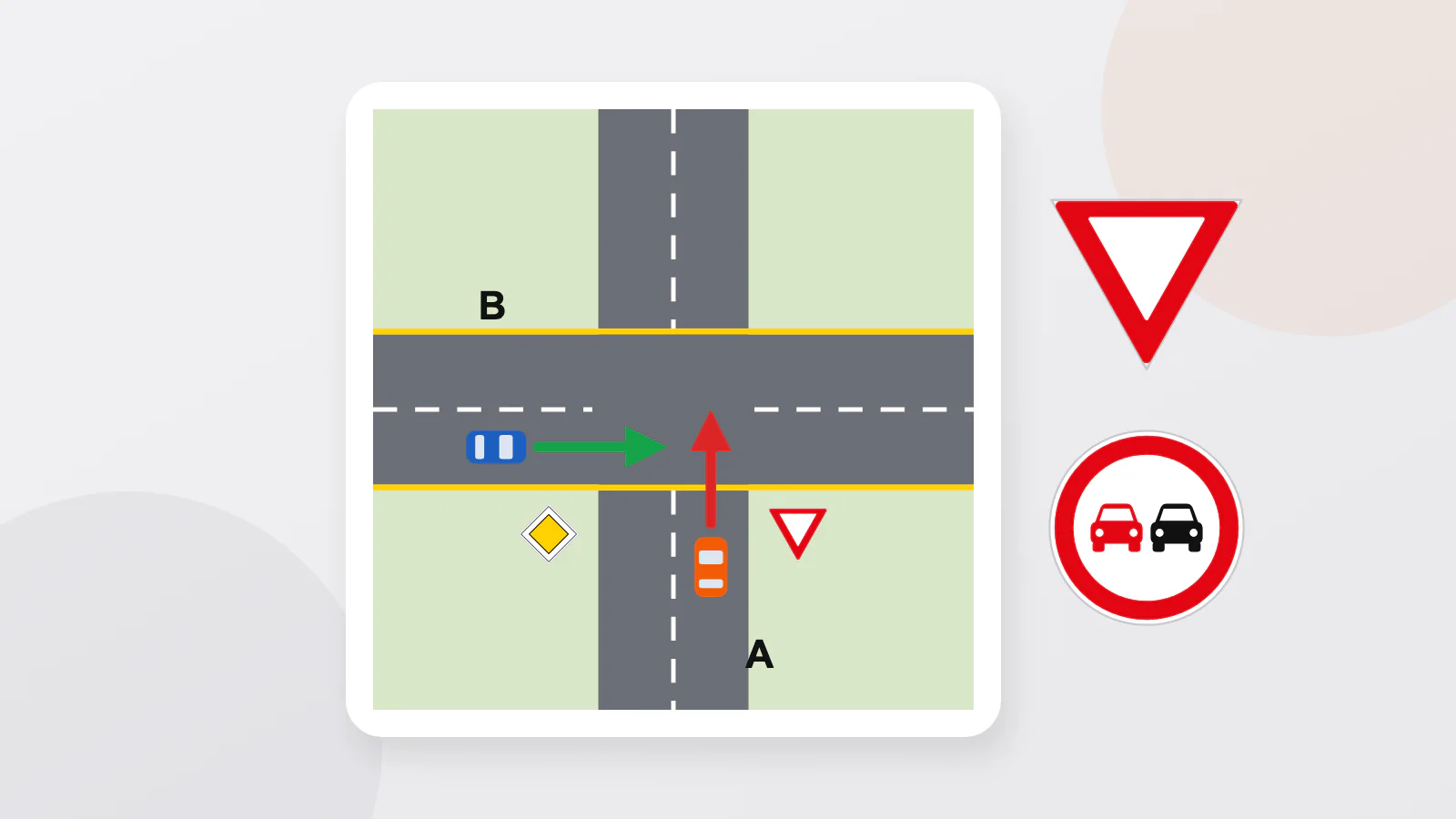
Three topics many learners find hardest in Uzbekistan's Road Traffic Rules are right of way at intersections, overtaking, and the difference between stopping and parking. In short: at a crossing of equal roads without signs you give way to the vehicle on your right; on a green light a car turning left gives way to oncoming traffic; overtaking is banned at regulated intersections, pedestrian crossings and on bridges; and stopping means standing for up to 10 minutes, while parking means longer.
First question: is the intersection regulated?
An intersection is regulated when traffic lights or a traffic controller decide the order of passing. If the lights flash yellow, are switched off, or there is no controller, the intersection is unregulated, and you follow the priority signs and the rules for unregulated intersections (clause 98 of the Road Traffic Rules).
When different signals disagree, clause 43 sets the order: a traffic controller's signals override traffic lights, signs and markings, and working traffic lights override priority signs. If the lights are not working, you may continue only after making sure that the lights for the crossing direction are off as well. On yellow after green, a driver who cannot stop without braking hard may continue (clause 42).
Who goes first at an unregulated intersection
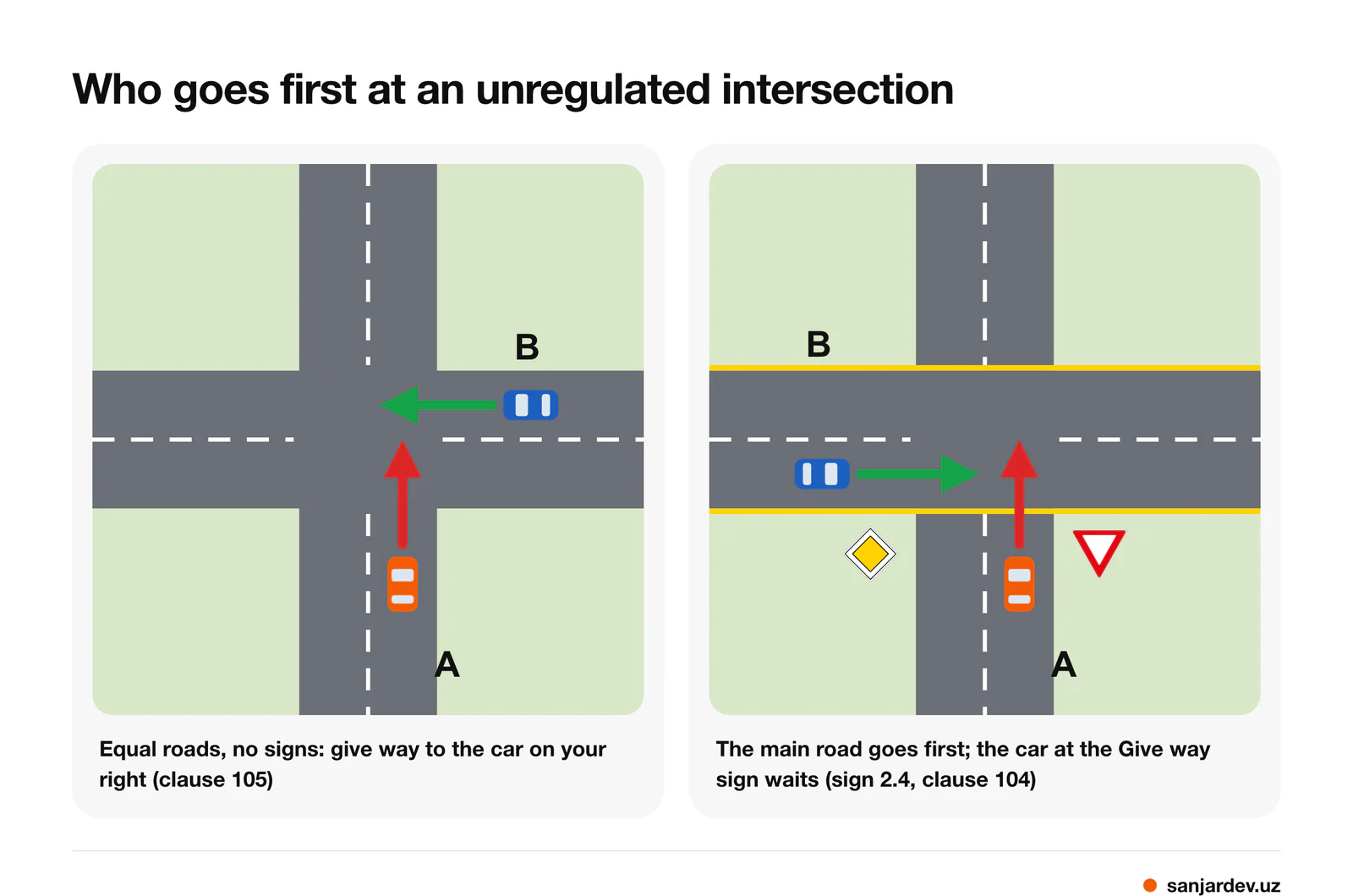
The rules work in two steps. First decide whether the roads are equal. A road is the main road if it is marked with signs 2.1, 2.3.1–2.3.3 or the motorway sign 5.1, if it is paved while the other road is dirt or gravel, or if the other "road" is an exit from a yard, parking lot or petrol station (clause 6). A short paved stretch of a secondary road near the junction does not make it equal to the main road.
- Unequal roads: the driver on the secondary road gives way to vehicles approaching on the main road, whatever direction they will take next (clause 104).
- Equal roads: you give way to vehicles approaching from the right (clause 105). Trams have priority over other vehicles at such intersections.
- If the main road turns at the intersection (plate 7.13 shows its shape), drivers on the main road use the equal-roads rule among themselves, and so do drivers on the secondary roads (clause 106).
- If you cannot tell whether your road is paved, for example at night, in mud or snow, and there are no priority signs, treat your road as the secondary one (clause 108).
Some worked examples:
- You drive straight across a crossing of two equal asphalt roads with no signs or lights. A car comes from your right and another from your left. You give way to the car on the right, and the car on the left gives way to you.
- You wait at a "Give way" sign on a secondary road. A car on the main road signals that it will turn into your road. You still wait: on unequal roads the secondary-road driver gives way regardless of where the main-road vehicle is going.
- You leave a residential courtyard onto a narrow street. The street counts as the main road, so you give way to everyone on it, pedestrians included (clauses 6 and 54).
- The traffic lights at a large intersection switch to flashing yellow at night. The intersection is now unregulated: look for the priority signs, and if there are none, apply the equal-roads rule.
Turning left and making a U-turn
The rules treat left turns the same way in every situation: a left-turning driver gives way to oncoming traffic going straight or turning right.
- On a green light, a driver turning left or making a U-turn gives way to oncoming vehicles going straight or turning right (clause 99).
- At an equal-roads intersection, the same applies (clause 107).
- Outside an intersection, a driver turning left or making a U-turn gives way to oncoming vehicles and to a tram in the same direction (clause 59).
- When the green comes on, let vehicles finish crossing and pedestrians finish walking first (clause 103).
Before turning right, left or round, take the extreme position on that side of the carriageway, except when entering a roundabout (clause 56). A U-turn is banned at pedestrian crossings, in tunnels, on and under bridges and overpasses unless signs allow it, at railway crossings, and wherever visibility in either direction is less than 100 m (clause 62). Reversing is banned at intersections and wherever a U-turn is banned (clause 63).
Roundabouts
At a roundabout, vehicles already moving on the circle have priority over vehicles entering it (clause 98). The blue round sign 4.3 marks the roundabout and the direction of travel, and the warning triangle 1.7 announces it in advance. Enter only when there is a gap, and switch on the right signal before you leave, as before any turn (clause 45).
Overtaking: what it is and where it is banned
In the rules, overtaking means passing one or more vehicles by moving into the lane meant for oncoming traffic and then returning to your lane (clause 6). Moving faster than a vehicle in the same direction without leaving your side of the road is not overtaking, and such passing is allowed on either side; a vehicle that is signalling and turning left is passed on the right (clause 83).
Before you overtake, switch on the left signal and make sure that the lane is free far enough ahead, that nobody behind you has started to overtake, that the vehicle ahead is not signalling a left turn or an overtake, and that you can return to your lane without cutting in (clause 82). The driver being overtaken must not speed up or otherwise hinder you (clause 84).
| Overtaking is banned | Clause |
|---|---|
| At regulated intersections | 86 |
| At unregulated intersections, when you are not on the main road | 86 |
| On bridges, overpasses and flyovers, and under them | 86 |
| At pedestrian crossings | 86 |
| At railway crossings and less than 100 m before them | 86 |
| When the vehicle ahead is itself overtaking or going around an obstacle | 86 |
| At the end of a rise and where visibility is limited | 86 |
| In the zone of signs 3.20 and 3.22 | 86 |
| Across a solid line 1.1 or 1.3 into the oncoming side | 64 |
| Into the oncoming lanes of a two-way road with four or more lanes | 65 |
Sign 3.20 does not stop you from overtaking a single vehicle moving slower than 40 km/h. Outside populated areas, a slow or very large vehicle should keep as far right as possible and, if needed, stop to let a queue pass (clause 87). Breaking the overtaking rules costs 3 BHM, or 1,320,000 so'm, while driving onto the oncoming side in breach of the rules is a separate offence of 10 BHM; see the full table of traffic fines.
Stopping and parking
The difference is time and purpose. Stopping means standing still for up to 10 minutes. Parking means standing still deliberately for more than 10 minutes for reasons other than letting passengers in or out or loading (clause 6). Wherever stopping is banned, parking is banned too, but not the other way round.
Stop and park on the right, on the shoulder or at the edge of the carriageway, parallel to it and in one row (clauses 88–89). In populated areas you may also stop and park on the left side of roads with one lane in each direction and no tram tracks in the middle, and of one-way roads. On the sidewalk edge, cars may park only where sign 5.15 stands with one of the plates showing how to park.
| Place | Stopping | Parking |
|---|---|---|
| At a pedestrian crossing and within 10 m before it | Banned | Banned |
| At an intersection and within 30 m of the edge of the road you cross | Banned | Banned |
| Within 15 m of a bus or tram stop sign (except letting passengers in or out without hindering route vehicles) | Banned | Banned |
| At a U-turn place and within 30 m before or after it | Banned | Banned |
| On railway crossings and in tunnels | Banned | Banned |
| On bridges and overpasses with fewer than three lanes in your direction | Banned | Banned |
| Where less than 3 m would remain to a solid line or the opposite edge | Banned | Banned |
| Within 50 m of a railway crossing | — | Banned |
| Outside populated areas, on the carriageway of a road with sign 2.1 | — | Banned |
| In the zone of sign 3.27 or line 1.4 along the curb | Banned | Banned |
| In the zone of sign 3.28 or line 1.10 | Allowed | Banned |
The stopping limits come from clause 91 and the parking limits from clause 92. Signs 3.27–3.30 work only on the side of the road where they stand, and their zone ends at the next intersection. Before you open a door, make sure you will not hinder anyone (clause 94), and leave the car only after securing it (clause 95). The signs themselves are explained in our guide to road signs of Uzbekistan, and the test that checks all of this in our article on the driving exam.
FAQ
Who goes first at an intersection with no signs in Uzbekistan?
If the roads are equal, the vehicle approaching from the right. If one road is paved and the other is not, or you are leaving a yard, the paved road or the street has priority.
Can you turn right on a red light in Uzbekistan?
Only where sign 5.42 stands next to the red light, or where a green arrow in an additional section allows it, and only after giving way to pedestrians and other vehicles.
What is the difference between stopping and parking?
Time and purpose: stopping is up to 10 minutes, parking is longer and not for passengers or loading. Sign 3.27 bans both, sign 3.28 bans only parking.
Who has priority at a roundabout?
Vehicles already on the roundabout have priority over those entering it (clause 98).
How Avtotest helps
Intersections, overtaking and stopping are separate topics in Avtotest, the app we develop for the theory test, so you can drill exactly the questions that cover these rules. After every answer the app shows the text of the relevant clause, and wrong answers stay in a list until you answer them right twice in a row; video lessons walk through the same rules. It does not replace practice on real roads with an instructor. One ticket and one exam a day are free; full access is a one-time payment for a month without auto-renewal. Questions are in Uzbek (Latin and Cyrillic) and Russian. Avtotest is not a government app and does not represent the Ministry of Internal Affairs or any other state body; the official rules are on lex.uz. Also available on Google Play.
Sources
- Road Traffic Rules, Cabinet of Ministers Resolution No. 172 of 12 April 2022, chapters 9–16 (edition of 30 October 2026) — lex.uz, 2026
- Road Traffic Rules in Uzbek Cyrillic — lex.uz, 2026
- Code of Administrative Responsibility, articles 128⁵, 128⁶ and 128⁹ — lex.uz, 2026
- Presidential Decree No. PF-115 of 23 June 2026 (base calculation amount) — lex.uz, 2026
Written by Sanjar Jabborov, developer of Avtotest. Checked against the Road Traffic Rules of Uzbekistan (lex.uz). Updated on 14 November 2026. This is general information: always follow the signs, markings and the traffic controller on the road. Avtotest is not a government app.